
Getting sewing patterns printed – here’s how
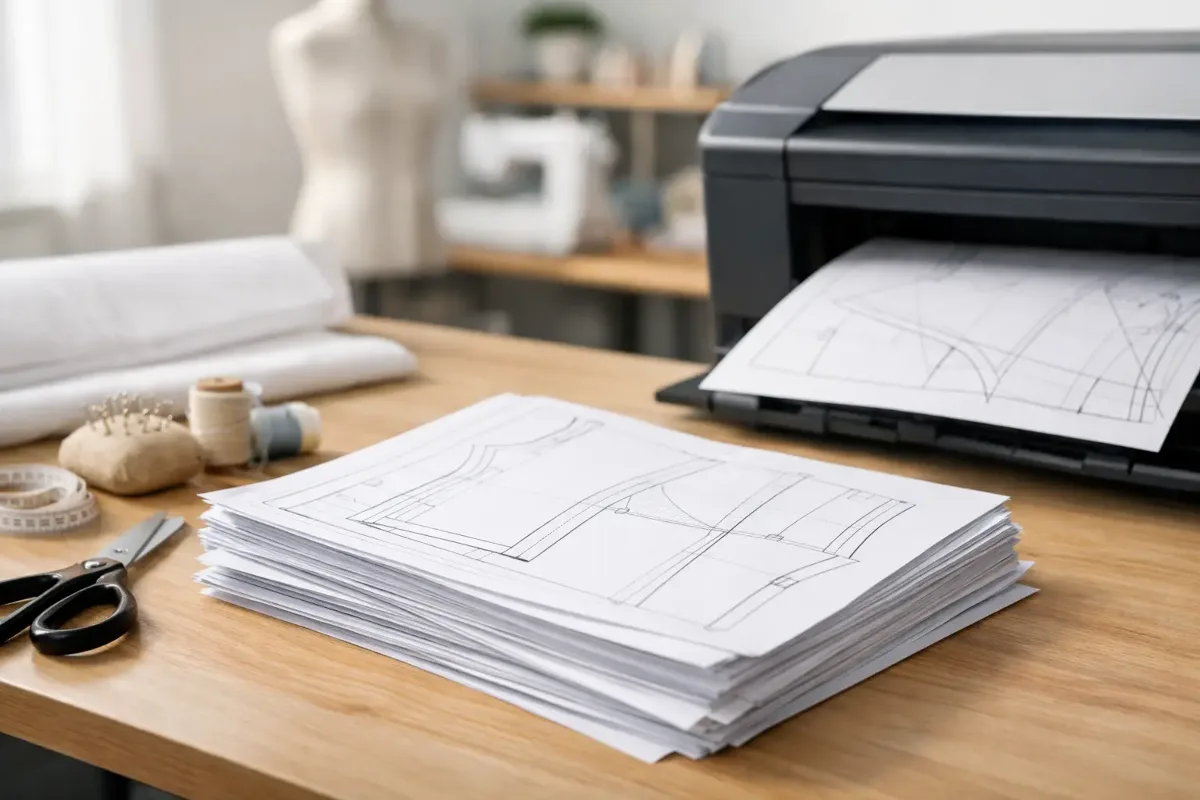
If you’ve ever printed a PDF sewing pattern at home across 30 or 60 sheets of A4, taped it all together and then realised the test square doesn’t measure up, you’ll know: getting sewing patterns printed is often the far more relaxed option. Especially if you’d rather sew than stick, a professional print saves you not only time but often your nerves and the space on your dining table too.
Why getting sewing patterns printed is often the better choice
Buying a digital sewing pattern is usually done in no time. The file is there, the excitement is there – and then comes the part most people like least: printing, sorting, trimming and taping. For small projects, that can still be fine. But with coats, dresses, children’s collections or patterns with lots of sizes, things quickly get confusing.
When you get sewing patterns printed, you receive the sheet at full size. That means: roll it out, weigh it down, pick your size and off you go. This is a real advantage for patterns with lots of notches, darts, panel lines or large pattern pieces. The lines stay clear and easy to follow, and you don’t have to fiddle with dozens of taped joins.
Then there’s something that’s often underestimated in everyday sewing: accuracy. One wrongly ticked ‘fit to page’ box in your printer settings is all it takes for the whole pattern to be ever so slightly distorted. Sometimes you only notice when the sleeves won’t fit into the armhole or a pair of trousers suddenly fits oddly.
Who benefits most from a printed sewing pattern?
Not everyone sews the same way, which is exactly why there’s no one-size-fits-all answer. If you only make the odd small children’s headband or a simple accessory now and then, printing at home will usually do the job. If you sew regularly, though, you’ll often get much more out of large-format printing.
The service is particularly handy if you’re short on time, don’t have a good printer or simply dislike taping. And if you work with several sizes – say, for children’s clothing or when sewing for different family members – a cleanly printed pattern sheet is often much easier to follow. Beginners also appreciate having one less source of error in their project.
More experienced sewists, on the other hand, usually love the convenience. When the pattern is ready to go, you can get straight on with choosing fabric, cutting out and making adjustments. That’s especially welcome when the project already demands plenty of concentration – for example with softshell jackets, viscose blouses or well-fitting trousers.
Which file do you need to get a sewing pattern printed?
It’s worth taking a closer look here, as not every PDF is automatically intended for large-format printing. Many pattern designers include several versions. Often there’s an A4 file for printing at home, and sometimes an A0 file or a copy shop file as well. That larger file is usually the right one to use if you want to get your sewing pattern printed.
An A0 or copy shop file already contains the pattern ready to print at full size. Ideally, all the pieces are complete, the scale is correct and there’s a test square for checking. Some files contain several sheets or extra layers for different sizes. That’s handy, but it’s worth a quick check before printing so that only what you actually need gets printed.
It’s also important that seam allowances, layers and markings on the pattern stay clearly visible. The cleaner the file, the more pleasant it is to work with later at the cutting table.
A4, A0 or copy shop – what’s the difference?
A4 is the classic home printing format. It’s easy to come by, but a lot of work for large patterns. A0 is a large format that suits many sewing patterns perfectly, as far more fits onto one sheet. Copy shop files are usually prepared specifically for professional printing and can consist of one or several large sheets.
In practice, it’s quite simple: if there’s an A0 or copy shop file, that’s usually the easier option. If there isn’t, printing on A4 at home is often the only choice.
What to look out for when printing
A good pattern sheet isn’t much use if the scale is off or the print is cut off. So it pays to check a few things beforehand. The most important is the scale. A test square of 5 x 5 cm or 10 x 10 cm should measure exactly right after printing. Even small deviations can affect the fit later on.
Complete pattern pieces are just as important. Some files have edge markings or sit very close to the page edge. Nothing should go missing unintentionally. Legibility matters a great deal too. When lots of sizes are nested on top of each other, the line styles, colours or line weights still need to be easy to tell apart.
It’s also handy if the sheet arrives neatly folded or rolled and doesn’t turn into chaos the moment you open it. Especially for larger projects, a clean, professional print quickly proves its worth.
What are the benefits of professional printing for everyday sewing?
The biggest benefit is the time you save. Instead of taping sheets together, hunting for the sticky tape and lining up paper edges, you can get straight on with the actual project. That’s particularly welcome if you want to prepare several patterns or only have limited time for sewing.
Then there’s the material you use. Printing at home often uses up plenty of paper and printer ink. For a single small pattern that hardly matters, but for bigger projects it soon adds up. In some cases, large-format printing ends up being not only more convenient but more economical too.
Another point is clarity. A large pattern sheet is often easier to read than a taped-together A4 layout. Notches, grainlines and size lines are easier to follow. That helps especially when you want to make alterations to the pattern or cut certain pieces several times.
Are there times when printing at home makes sense?
Yes, absolutely. If you need a pattern at very short notice and want to get started right away, your home printer is of course handy. The same goes for small files or test projects where you first want to see whether the shape and style suit you at all.
A4 can also be enough if you usually only cut a single size and the file is very clearly laid out. It’s less a question of right or wrong and more about how much effort you want to put in. For spontaneous, small projects, printing at home is fine. For larger, recurring or more demanding sewing projects, professional printing is often the more pleasant option.
The most relaxed way to go about it
If you’d like to get a sewing pattern printed, start by looking at your file. If there’s an A0 or copy shop version, that’s usually the best starting point. Then quickly check whether it contains several size layers and whether all the pieces you need are actually on the sheet. If there’s a test square, measure it after printing.
It’s also worth thinking ahead about how you’ll work with it. Will you trace your size from the original sheet, or cut the sheet out? If you often need several sizes or want to sew the pattern again later, tracing is usually the better option. That way the original sheet stays intact.
This service is especially helpful from a well-stocked specialist shop with a focus on sewing, because they understand what really matters with sewing patterns. That’s exactly why printing PDF sewing patterns at full size fits so well into the range at Die Stoffkönigin – as practical support for everyone who wants to start their project without any detours.
What a good printing service should offer
Not every print is automatically a good pattern print. What matters is correct scaling, clean lines and a format that suits the pattern. On top of that comes a service mindset that genuinely helps in practice. When you sew, you don’t want unnecessary back-and-forth – you want a print you can rely on.
So it helps to choose a provider who knows about sewing patterns and doesn’t just put any old PDF on paper. After all, sewing patterns aren’t posters or construction plans. They need to be legible, true to size and easy to handle in everyday sewing.
So if you regularly buy digital patterns, it’s worth taking an honest look at how you work. How much time goes on taping? How often do crooked edges or confusing sheets drive you mad? And how lovely would it be to simply spread out your fabric, lay the pattern next to it and get going straight away?
Sometimes that’s exactly the best decision for a relaxed sewing project: less paper chaos, more excitement at the cutting table.


