How to Choose the Best Embroidery Threads for Beginners
A little flower motif on a tote bag, a name on a baby's bib or delicate lettering on a denim jacket: you don't need a huge stash of supplies to get started. Choosing the best embroidery threads for beginners does make a noticeable difference, though. Good threads glide nicely through the fabric, separate easily and forgive the odd stitch that isn't quite even yet.
If you're embroidering for the first time, you'll often be faced with lots of colours, weights and fibres. Choosing doesn't have to be complicated. The first thing to decide is whether you're stitching by hand or with an embroidery machine, which design you have in mind and what fabric you'll be stitching on. Then you'll quickly find a thread that makes embroidery a real pleasure.
Best embroidery threads for beginners: cotton is a safe start
For most hand embroidery projects, classic cotton stranded thread is the best choice. This thread is usually made up of six fine, loosely twisted strands. You can use all six strands if you want your design to look bold, or separate out individual strands for delicate lines, faces or small details.
It's exactly this flexibility that makes stranded cotton so beginner-friendly. For a simple flower on cotton fabric, two to three strands are often enough. For clearly visible lettering on a bag, you can use four to six. That way you don't have to buy a new thread weight for every design – you simply adapt the thread you already have to the project.
Look for a neat, even twist and good colourfastness. Very cheap threads can fluff up, snap more easily or lose colour in the wash. That doesn't mean you need every colour in large quantities straight away. Small colour selections are a sensible way to try things out. At Die Stoffkönigin you can also choose materials and colours to suit the project you're planning – without building up an unnecessary stash in your craft cupboard.
How many strands you really need
The number of strands affects how fine or textured your embroidery looks. There's no single right setting, as fabric, needle and design always play a part. As a simple guide: one to two strands are ideal for fine outlines and small lettering, and two to three strands for most floral and pictorial designs. Four to six strands create a more defined, softer filled area and work well on coarse fabrics or for deliberately bold accents.
Pull the strands you need out of the stranded cotton one at a time rather than splitting the whole length into two bundles. That way the thread twists less. Then lay the single strands back together and thread them through the needle. This little trick will save you a lot of patience later on.
Which other types of thread are worth considering
Stranded cotton is the all-rounder, but it's not the only option. Depending on the style and project, other threads can look lovely too. When you're starting out, it's worth getting to know their properties rather than simply reaching for the prettiest colour.
- Perle cotton is tightly twisted, has a subtle sheen and can't be separated. It creates a clear, slightly raised line and works well for visible outlines, cross stitch and decorative details.
- Crewel wool brings warmth and volume to a design. It looks particularly beautiful on felt, boiled wool or coarse woven fabrics, but it's usually too thick for tiny details on thin fabric.
- Metallic thread adds sparkling highlights to stars, Christmas motifs or lettering. It can twist and fray more easily, so it's better as an accent thread than as the first choice for a whole design.
- Machine embroidery thread is made for the high speed of an embroidery machine. It's smooth and strong, but behaves differently from classic stranded cotton when you stitch by hand.
So for your first hand embroidery project, you don't need metallic thread or speciality fibres. Use stranded cotton as your basis and add to it later when you fall for a particular look. This keeps your choice of materials manageable and helps you develop a feel for stitches and thread tension.
Don't mix up hand and machine embroidery thread
Threads on small spools can sometimes look similar, but they're designed for different purposes. Hand embroidery thread can have a little grip as you pull it through the fabric. Machine embroidery thread, on the other hand, needs to run evenly and quickly through the machine, needle and tension guides. If you work with an embroidery machine, you'll need thread designed for it, plus the right bobbin thread.
Polyester and viscose embroidery threads are especially popular for machine embroidery. Polyester is hard-wearing, colourfast and well suited to children's clothes, towels or sportswear that get washed often. Viscose has a particularly beautiful sheen and looks elegant on delicate designs, but needs a little more care where there's friction and heavy wear.
One important point: if a machine design comes out messy or the thread snaps, the thread isn't automatically to blame. Needle size, stabiliser, thread tension and fabric can all be the cause. Always test new combinations on a scrap first. It takes a few minutes and protects your actual project.
Colour, fabric and needle need to work together
Even the most beautiful thread colour looks different once it meets fabric. A cream thread can almost disappear on white, yet glow softly on dark blue linen. Lay thread and fabric side by side in daylight before you decide. For children's clothes or gifts, it helps to pick up an accent colour from the fabric's print. The result then looks calm and deliberately coordinated.
The type of fabric also determines how easy it is to embroider. Firm cotton woven fabric, linen and canvas are pleasant for beginners because they sit stably in the embroidery hoop. On jersey, sweatshirt fabric or other stretchy fabrics, you'll usually need a stabiliser or tear-away backing so the design doesn't distort. Very thin fabrics call for fine thread, a small needle and particularly gentle hooping.
The needle should have a large enough eye so the thread doesn't get worn. At the same time, it mustn't punch too big a hole in the fabric. For two to three strands of stranded cotton, a medium embroidery needle is often a good start. If you have to tug noticeably to pull it through, either the needle is too small, the fabric too dense or you're using too many strands.
The most common beginner's mistake: threads that are too long
A long thread seems to save time, but it rarely makes stitching any faster. It twists, knots more easily and rubs against the fabric every time you pull it through. A thread length of around 40 to 50 centimetres is easy to manage for most designs. If you're working with several strands, it can be a little shorter.
Every so often while you're stitching, let the needle hang freely. This lets the twist in the thread unwind. Also, only pull the thread tight enough for it to lie neatly on the fabric. Too much tension puckers the fabric and robs the design of its lovely, even shape.
A handful of basic stitches is all you need to begin with: backstitch for lines and lettering, satin stitch for small filled areas, stem stitch for curved outlines and French knots for flower centres. With good cotton thread, a suitable needle and fabric that's firmly hooped, these stitches already look really effective.
A small starter kit you'll actually use
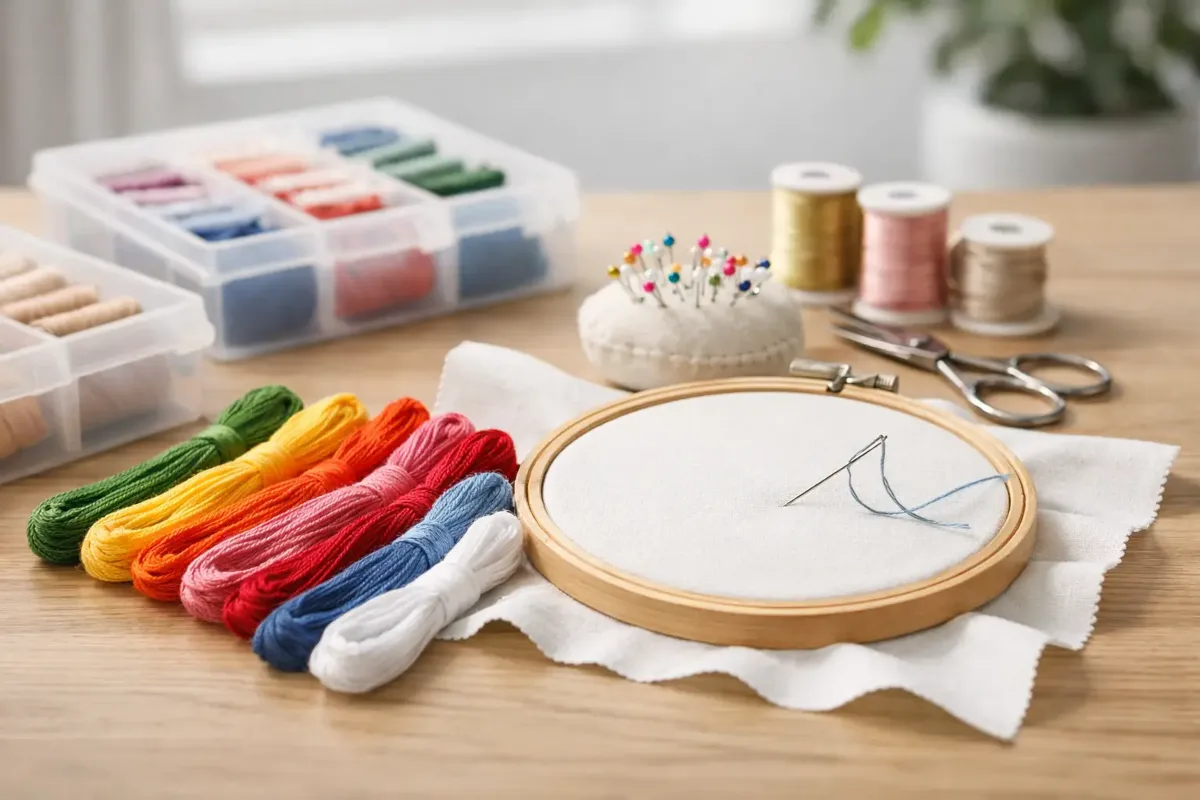
Rather than stocking up on lots of speciality threads, it's better to put together a manageable selection: a few colours of stranded cotton, an embroidery needle with a medium eye, an embroidery hoop, small scissors and a light-coloured cotton fabric to practise on. Then, for a specific project, choose exactly the colours and quantities you need. Small amounts of materials are especially handy for your first designs, as you can experiment without piling up leftovers.
Feel free to start with a design that doesn't have to be perfect: a leaf, a heart or the first letter of a name. When thread, fabric and needle work nicely together, your confidence grows with every stitch. And before long you'll no longer reach for the first thread that comes to hand, but for exactly the thread that shows your project off at its best.