Review: How to Judge Jersey Fabric Quality
After its first wash, a T-shirt can fit just as beautifully as before – or it can suddenly look twisted, lose its shape and ripple along the seams. That's exactly why it pays to take a close look at jersey fabric quality before you start cutting. Not all jersey is the same: fibre content, weight, knit structure and elasticity decide whether your fabric becomes a favourite garment or a project that tests your patience for no good reason.
Especially for children's clothes, tops, dresses or leggings, the fabric can be soft, but it should also move with you and hold its shape. You can't spot good quality by a single feature. Only the combination of handle, recovery, finish and the right intended use gives you a reliable picture.
What makes good-quality jersey
Jersey is a knit fabric. Unlike woven cotton, it's made from interlocking loops. That makes it stretchy, soft and comfortable against the skin. At the same time, its cut edges can curl and it reacts more sensitively to pulling than a firm woven fabric. These properties are simply part of the material and aren't a sign of poor quality.
When it comes to quality, what matters is how evenly the fabric is knitted, how the surface feels and how well it returns to its original shape after stretching. A high-quality jersey has a calm, dense knit with no noticeably large holes or thin patches. It feels pleasant without being limp, and it stretches evenly across the grain.
The fibre content also gives you important clues. Cotton jersey with a small percentage of elastane is a tried-and-tested all-rounder for close-fitting clothes. Cotton provides a natural, skin-friendly feel, while elastane adds freedom of movement and helps the fabric keep its shape. Viscose jersey often drapes more softly and fluidly, but it can need a little more care when cutting and sewing. For leggings, bodysuits or fitted tops, a jersey with enough stretch is particularly important. For a loose-fitting top, on the other hand, the fabric can have a bit less stretch.
The fabric weight, usually given in grams per square metre, also helps you assess it. A lightweight jersey is wonderful for summery tops or airy dresses. A medium weight is versatile and often ideal for T-shirts, harem trousers and children's clothes. Heavier jersey usually looks more opaque and stable, but it may drape less fluidly in very delicate designs. So thicker doesn't automatically mean better – what counts is what you want to sew.
Jersey fabric quality review: what to look out for
The handle tells you more than first impressions
Take the fabric in your hand and scrunch it up gently. Does it feel pleasant, even and high quality? That's a good sign. A very smooth jersey can be top quality, but it shouldn't feel artificially stiff or unpleasantly coated. A soft, skin-friendly handle matters especially for baby and children's clothing.
Also hold the fabric up to the light. With very pale or heavily stretched fabric, it's natural for the structure to show through. But if you can see uneven, noticeably thin areas even when the fabric is relaxed, be cautious. Opacity is an important point for pale leggings or close-fitting tops, and less so for a loose summer top.
Stretch and recovery determine the fit
Pull the jersey apart across the selvedge and then let go. Good fabric quickly springs back into its original shape. If the fabric stays visibly stretched out or starts to ripple, the finished garment may bag out sooner – at the knees, elbows or neckline, for example.
Bear in mind that more stretch isn't always the best choice. A top pattern designed for jersey with little stretch may come out too big in a very stretchy fabric. Conversely, snug leggings need plenty of elasticity so they're comfortable and easy to pull on. So always check the fabric recommendation in the sewing pattern. It's not a minor detail – it's part of the fit.
The knit should look calm and even
Turn the jersey over to the wrong side and look at both sides. With a well-made fabric, the knit looks regular. The odd small irregularity can occur with natural fibres and usually isn't a problem. But if you find lots of loose threads, uneven rows or tiny ladders, you may notice it later when sewing.
A clean fabric also makes cutting easier. Motifs sit more clearly, edges distort less and you can guide your seams more evenly. This is especially helpful if you've only sewn a few jersey projects so far or want to place a large-scale design precisely.
Print and colour need to suit the project
A beautiful motif alone doesn't make a good fabric. Check whether the print looks rich, crisp and even. With printed jersey, the colour shouldn't pull apart so much when stretched that a pale base shows through clearly. A certain amount of this is normal when stretched hard, but for leggings or very close-fitting garments you should take a closer look.
Dark colours may release some excess dye in the first wash. So it's best to prewash new jersey fabrics separately before sewing, following the care instructions. This not only prevents colour transfer but also accounts for any slight shrinkage. That way, you cut your project with realistic measurements.
The right jersey for your sewing project
For a classic T-shirt, cotton jersey with elastane usually works very well. It's comfortable to wear, straightforward to sew and moves with you through everyday life. For children's clothes, the fabric can be a little sturdier, as rough-and-tumble play, frequent washing and constant dressing and undressing put both fabric and seams to the test.
For dresses with a softly swinging skirt or loose, flowing tops, viscose jersey is often a particularly lovely choice. It skims the body and drapes elegantly. On the other hand, it can be more slippery to cut than cotton jersey. If you don't have much sewing experience yet, you'll usually find a slightly firmer cotton jersey more relaxing to work with.
For leggings, sportswear or fitted bodysuits, you need a jersey with good elasticity and reliable recovery. This is where a sufficient elastane content pays off. For cuffs and bands, however, dedicated ribbing is the better choice: it's made to stretch a lot and then hug snugly again. Regular jersey is only a sensible substitute if the pattern specifically allows for it.
How to test jersey before cutting
A small test piece often saves more time than any rescue mission on a finished garment. Prewash the fabric if you plan to wash the garment later. Then sew a short test seam using the needle, thread and stitch you intend to use. For jersey, a jersey or stretch needle works well, along with a stretch stitch, a narrow zigzag or an overlocked seam.
Gently pull the sample apart. The seam should stretch with it without threads snapping or the fabric edge rippling badly. Ripples aren't necessarily caused by poor fabric quality. Often the culprit is tension that's too high, a stitch that's too long or unsuitable, a blunt needle or pulling the fabric while sewing. A walking foot can also help with very soft or slippery jerseys.
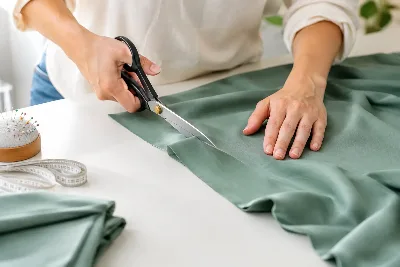
Always cut jersey on a flat surface and pay attention to the grain. On most jerseys, the greatest stretch runs across the fabric, perpendicular to the selvedge. If the fabric is twisted when you lay it out or you ignore the grain, a top may hang crookedly after washing, even though the jersey itself is perfectly fine.
Putting price, certifications and expectations into perspective
A higher price can reflect elaborate prints, a special fibre blend or careful production. But it isn't automatic proof of quality. Equally, a fairly priced jersey can be very reliable if the material, weight and finish suit your project. Rather than looking only at the price per metre, it's worth reading the product description: fibre content, width, weight, care instructions and any certifications give you a much better basis for your decision.
Certifications can be a useful extra guide, especially for baby and children's clothes. However, they don't answer the question of whether the fabric is right for your pattern. A certified lightweight jersey may still be too thin for trousers that get a lot of wear. Quality always shows in use.
If you're torn between two jerseys, don't just think about the print. Ask yourself: how should the garment fit, how often will it be worn and how much movement does it need to cope with? Making this small decision first will help you find a fabric more quickly that doesn't just look amazing on the shelf or on screen, but is still a joy to wear after many washes. And if you're still unsure, a personal opinion on your planned project from Die Stoffkönigin often helps more than simply comparing numbers.