Which fabric really works for a table runner?
A table runner transforms your dining table faster than a new dinner service: it adds colour to a plain tabletop, frames a festive place setting or protects your everyday table from little accidents. But which fabric you choose for a table runner decides whether the result drapes nicely, is easy to sew and still looks good after washing. Not every fabric that looks lovely on the shelf is right for every occasion.
For a runner that spends most of its time on the dining table, easy care and a pleasant feel matter most. If it's meant to sit on a sideboard as decoration, on the other hand, the fabric can be finer, more textured or more delicate. Whether children sit at the table also makes a real difference when choosing your material.
Which fabric for an everyday table runner?
For daily use, woven cotton is usually the most straightforward choice. It feels nice to handle, cuts cleanly, presses well and can generally be washed without any fuss. Cotton woven fabric also comes in a huge range of colours and designs – from understated plains and florals to cheerful prints for the family table.
A cotton table runner looks neither too stiff nor too formal. It's just as at home at a family breakfast as at a weekend afternoon tea. Especially handy: spilt juice, crumbs or small stains are far less stressful to deal with on a washable cotton than on very delicate home décor fabrics.
Pay attention to the fabric quality. Lightweight patchwork cotton can be wonderful for narrow, decorative runners, but may look a little thin on a wide or very long one. A medium-weight woven fabric often has more body and still lies beautifully on the table. If you're after a particularly calm, high-quality look, plain cottons make a great base. You can then bring in pattern through napkins, crockery or seasonal decorations.
Linen and linen blends for a natural look
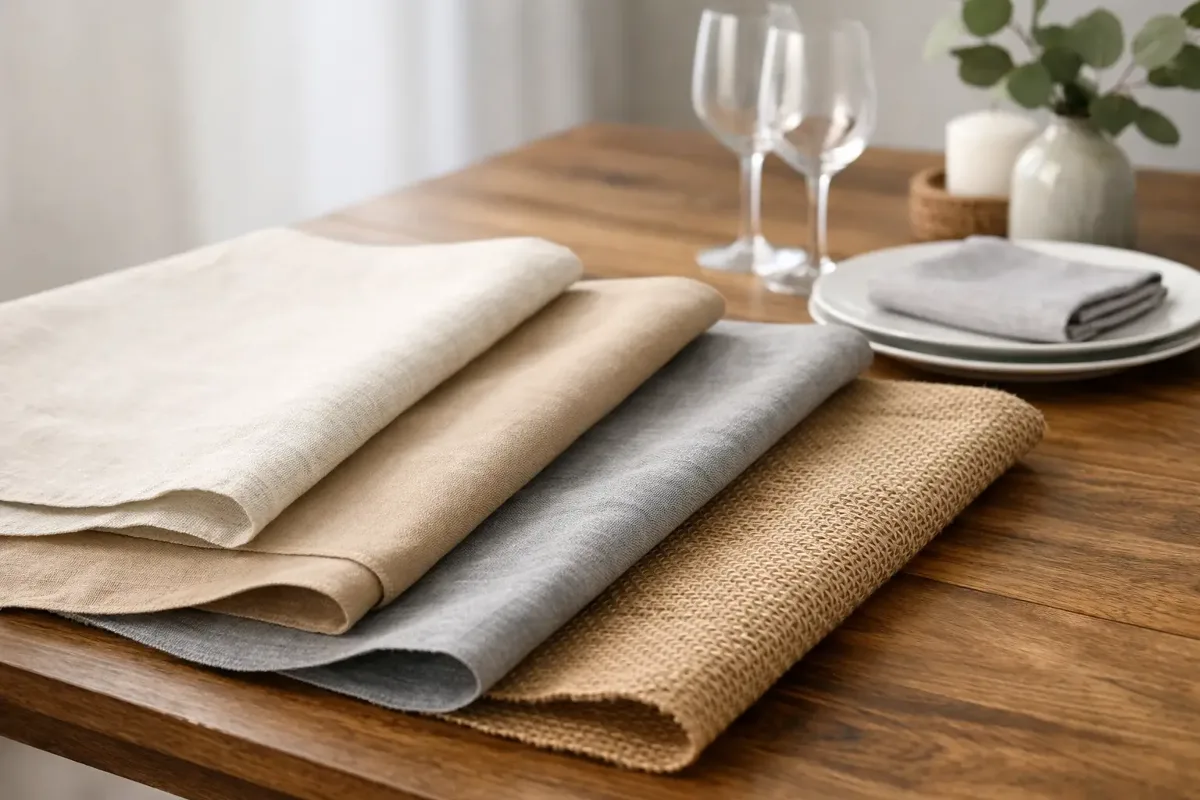
Linen is the classic choice for natural, timeless table styling. It has a lively texture, feels lovely and goes beautifully with wood, ceramics and simple vases. Especially for a country-style table or a summery afternoon tea, linen brings that relaxed sense of quality that doesn't need to look polished.
Pure linen does crease noticeably, though. That's part of the material's character – and for many people, exactly its charm. If you prefer a smoother look or want to use your runner often, a linen-cotton blend is often the better option. It combines the beautiful look of linen with a little more ease of care and a more even drape.
Always prewash linen and linen blends before cutting. Natural fibres can shrink, and you don't want your finished runner to suddenly come up short after its first wash. Ideally, wash the fabric the same way you plan to wash the finished table runner later on.
Canvas: the sturdy fabric for a runner with body
Canvas is a heavyweight cotton woven fabric and a very good choice if you want your table runner to have a bit more stability. It lies flat, doesn't slip as easily and is pleasingly hard-wearing. It's particularly suited to wide runners, dining tables that see a lot of use, or projects where you want a clean, modern shape.
Canvas also works nicely for matching placemats, bread baskets or fabric storage baskets, so a single fabric design becomes a coordinated set for your table. Because it's so firm, though, canvas can get a little bulky at the edges, especially with a double-folded hem. A suitable universal needle and sewing slowly around the corners help a lot.
Visually, canvas looks a bit more rustic than fine cotton or linen. That's not necessarily a drawback: on a large wooden table, in the garden or in a home with children, its no-nonsense style is often just right. For a very festive table with delicate china and fine glassware, linen or a smoother cotton is usually the more elegant choice.
Coated fabrics for stains and little ones
If your table runner is mainly there to protect, coated cotton is well worth a look. It has a water-repellent surface, and small spills can often simply be wiped off with a damp cloth. That's particularly practical on the kitchen table, during craft sessions, at mealtimes with children or outdoors on the garden table.
Coated fabric is usually less soft in its drape than regular cotton and looks more functional, so it isn't always the first choice for festive table décor. As a wipe-clean everyday runner, however, it can save you a lot of work. Take care with the coating when ironing: only iron from the wrong side on a low setting, ideally with a pressing cloth between the fabric and the iron.
Fine fabrics for special occasions
For Christmas, a wedding, a milestone birthday or a particularly elegant table, a runner can be a little more refined. Textured home décor fabrics, jacquard, layered muslin or fabrics with a subtle sheen all add beautiful accents. Here, the look clearly comes before everyday practicality.
Muslin drapes softly and loosely and suits natural, romantic table styling wonderfully. Its open weave is less suitable, however, if the runner needs frequent washing or should lie very flat. Jacquard has its pattern woven right into the fabric and looks luxurious, but may need a little more care when sewing and hemming.
Very slippery fabrics such as satin are best avoided for a classic table runner. They may shine, but they slip about easily and often show stains quickly. If you'd like a festive shimmer, a textured décor fabric is usually the more practical alternative.
Planning size and fabric quantity
Before you choose your fabric, it's worth thinking briefly about the length you want. A table runner can hang over the edge of the table at both short ends. As a guide, an overhang of around 15 to 30 centimetres per side looks balanced. On a table 180 centimetres long, that gives a finished runner length of roughly 210 to 240 centimetres.
On top of the finished length, add seam allowance for the two short ends. If you'd like to turn under the long edges too, allow a little extra fabric in the width as well. Runners are often made between 35 and 50 centimetres wide. Narrower versions look good on small tables and sideboards, while a wider runner has more presence on a large dining table.
Also check the fabric width. Many cottons are around 140 centimetres wide, so you can often cut several narrow runners from a single metre. With directional prints – such as flowers, animals or lettering – the pattern should of course run the way you want it to. For large pattern repeats, it's best to buy a little extra so the design sits nicely at both ends.
How to get a neatly sewn finish
A simple table runner is an ideal project for beginners. The easiest method: prewash the fabric, cut it out accurately, neaten all the edges and turn under a narrow double hem all the way round. Then edgestitch close to the fold. A matching thread keeps the stitching discreet, while a contrasting thread can become a deliberate design feature on canvas or a modern plain fabric.
If you'd like the edges to stand out a bit more, you can use bias binding. This works especially well with children's prints, checked woven fabrics or a runner coordinated with your chairs or napkins. On linen, a simple, neatly pressed hem usually looks calmer and more refined.
A lining only makes sense if the fabric is very thin or see-through, or if you'd like the two sides to look different. For most cotton, linen and canvas runners, a single layer of fabric is perfectly enough. Too many layers make the runner unnecessarily thick and stop it lying in a relaxed way on the table.
Matching your fabric to the table and the occasion
A white-painted table can take bold prints and rich colours, because the runner instantly becomes the focal point. On a strongly grained wooden table, calm plains or small prints often look more harmonious. If your crockery already has a striking pattern, the table runner can happily take a back seat. Conversely, a patterned runner shows off plain crockery beautifully.
For everyday use, cotton, linen-cotton blends and canvas are the most reliable materials. For the garden table or a busy family home, coated cotton is a practical addition. And when your table décor is for a special moment, texture, sheen and fine fabrics can take centre stage.
If you're torn between two fabrics, go for the one that suits your real everyday life – not just a perfectly styled photo. In the end, the best table runner is the one that gets used often, washes without fuss and goes back on the table with a smile.