How do I repair clothes? Practical tips
A favourite top with a small hole, a split side seam or a missing button on a child's jacket doesn't have to mean the end of a garment. If you're asking yourself, “How do I repair clothes?”, you usually don't need a big sewing project, just the right technique, a little patience and supplies that suit the fabric. Many repairs take only a few minutes and extend the life of clothes you love to wear.
Look first, then sew
Before you pick up a needle and thread, take a close look at the damaged area. Has a seam simply come undone, or have the fabric fibres themselves torn? With a hole, the type of fabric also matters a great deal: a woven fabric such as cotton poplin, canvas or denim behaves differently from stretchy jersey, ribbing or fleece.
If the garment is dirty, wash it before you repair it. Stains are harder to treat afterwards, and clean fabric sits more calmly in your hands while you sew. Don't trim loose threads too close to the fabric. They can still be useful when closing a seam, or show you how the original stitching ran.
Lay the garment flat and gently pull the area apart. This lets you see whether the seam allowance is still there. If it is, the seam can usually be closed neatly. If fabric is missing or the material around the hole has worn thin, the area needs reinforcing rather than simply stitching together.
A small repair kit for home
A few good-quality supplies will cover most situations. Particularly handy are hand-sewing needles in various sizes, a seam ripper, a small pair of sharp fabric scissors, pins or fabric clips and a tape measure. Add sewing threads in commonly worn colours such as black, white, grey, beige, navy and red.
Choose a thread that matches the fabric as closely as possible. Standard all-purpose thread works well for fine blouse fabrics and cotton. For jersey and other stretchy fabrics, elastic thread is helpful, but you can also sew flexibly by hand with ordinary quality thread as long as you don't pull the stitches too tight. For denim, workwear or bags, a heavier thread is a good choice.
Small fabric scraps are also useful. A scrap of jersey fits nicely beneath a hole in a T-shirt, and a cotton remnant can stabilise the inside of a pocket that has worn thin. Interfacing or iron-on repair patches are a quick fix, but use them with care on delicate fabrics and very stretchy clothing. They won't withstand every movement in the long run and can make the area slightly stiffer.
Closing split seams neatly
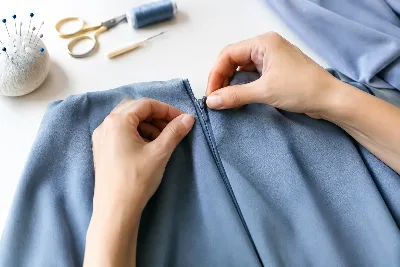
A split seam is the most rewarding repair. Turn the garment inside out and line up the two fabric edges as they originally sat. Pin or clip the area in place. Start one to two centimetres before the open section so that your new seam overlaps securely with the existing one.
Sew small backstitches along the original seam line. With backstitch, the needle first goes back a little and then comes up again ahead of the last stitch. This creates a firm, durable hand-sewn seam that comes quite close to a machine seam. At the end, sew a little way past the intact seam as well and secure the thread on the inside with two small knots.
On jersey, a small overcast stitch is often more comfortable when the seam edges sit right next to each other. Only pull the thread tight enough to bring the edges together. A seam that is too tight can tear again when you put the garment on. If you're using a sewing machine, a narrow zigzag or a stretch stitch is a better choice than a rigid straight stitch.
Repairing small holes in T-shirts, jersey and knitwear
A tiny hole in a top is often caused by friction, a snag or a damaged washing machine drum. Don't simply pull the edges together, as this distorts the fabric and leaves an unsightly pucker. Instead, place a matching fabric scrap or a thin iron-on interfacing on the wrong side of the area.
On jersey, a fine, discreet repair works well with small stitches around the hole. Catch only a few fibres at a time and work in the direction of the knit. A thread in a similar colour will be least noticeable. If you'd like the repair to show, you can of course get creative: a small appliquéd star, a patch or some embroidery protects the area and gives the garment a new character.
Knitwear needs a careful touch. If a stitch has come loose, secure it first with a safety pin so the hole doesn't run further. With a blunt darning needle and matching yarn, you can pick the stitch back up. With very fine knits, this method is especially worthwhile if you work calmly and in good light. Otherwise, a small piece of fine fabric sewn on from the inside will cover the damaged area more reliably.
Reinforcing holes in jeans and woven fabrics
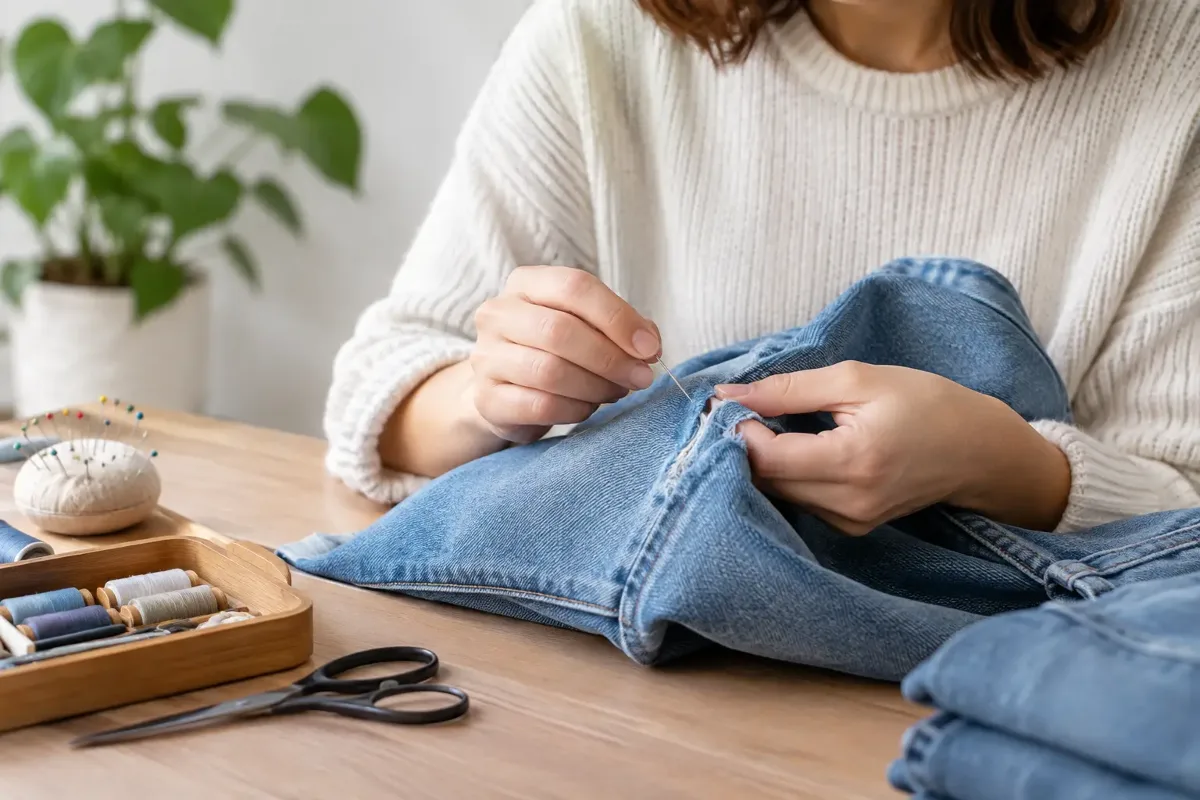
With jeans, simply sewing the torn edges together is rarely enough. Especially at the knees, pockets and crotch, the fabric is often weakened over a large area. First, carefully trim back any frayed threads without making the hole bigger. Then place a sturdy patch underneath from the inside, extending at least two centimetres beyond the thin area on all sides.
Hold the patch in place with pins, fabric glue or a few tacking stitches. Then sew closely spaced lines across the damaged area. On a machine, short straight stitches sewn several times in alternating directions work well. By hand, you can attach the patch with small running stitches plus an extra edge stitch.
A visible denim patch isn't a makeshift fix; it can be a deliberate part of the design. Contrasting thread, a patterned cotton fabric or a neatly applied patch look especially lovely on children's trousers and casual jeans. For a discreet repair, choose a patch in a similar colour and sew it in from the inside.
Repairing and shortening hems
If a hem comes loose, first carefully press it back into its original shape. The old pressed fold is your best guide. Turn the edge under, pin it in place and sew it with a hemming stitch. Pick up just a few fibres of the outer fabric so that as little thread as possible shows on the right side.
On jeans and sturdy fabrics, the hem can be visibly topstitched. Use a heavier thread or a suitable denim thread for this. On lightweight trousers, skirts or dresses, a fine blind stitch usually looks nicer. Make sure you don't stretch the hem while sewing, otherwise it may hang in waves later.
Reattaching buttons, press studs and hooks
A button shouldn't just be secure; it also needs enough space between it and the fabric. On shirts, jackets and coats in particular, the button needs a small shank so the buttonhole can slide over it easily. To create one, place a matchstick or a thick needle between the button and the fabric as you sew. After several stitches, remove the spacer, wind the thread a few times around the resulting loop of thread and fasten it off on the back.
With four-hole buttons, check the existing pattern: parallel, crossed or square. If there are other buttons on the garment, follow their lead. Press studs and hooks must be sewn on especially securely, as opening them puts strain on the stitching. It's better to sew several small stitches through each hole than a few large ones.
What to do if a zip sticks
A zip that's merely sticking often isn't broken yet. First check whether any fabric threads are caught in the slider. Gently free them with tweezers without forcing anything. A little dry candle wax or a line of pencil graphite along the teeth can help metal and plastic zips run more smoothly again.
If individual teeth are bent or a piece is missing, replacing the zip is usually the longer-lasting solution. The same applies if the slider keeps splitting open. On cushion covers, skirts or simple bags, a zip is fairly easy to replace. On lined jackets, outdoor clothing or very delicate dresses, the job is more demanding because the lining, seams and often several layers of fabric are involved. In these cases, an alterations tailor may be the more sensible choice.
How do I repair clothes so the fix lasts?
The best repair is one that suits the material and how much wear it gets. A thin patch on heavily worn jeans won't last long, whereas a clearly reinforced area will often survive many more washes. Wash repaired clothes according to their fabric and avoid high temperatures if you've used iron-on interfacing or stretchy fabrics.
When you sew, keep small leftovers from your projects, sorted by fabric type and colour. That way, especially for children's clothes, tops or handmade bags, you'll quickly find a suitable piece for reinforcing. At Die Stoffkönigin, you can buy fabrics in small quantities - handy when all you need for a repair is a small, well-matched piece.
Not every repair needs to be invisible. A carefully sewn seam, a colourful patch or a little embroidery shows that this garment was too good to throw away - and often makes it even more your own.