How to Choose the Best Fabrics for a School Cone
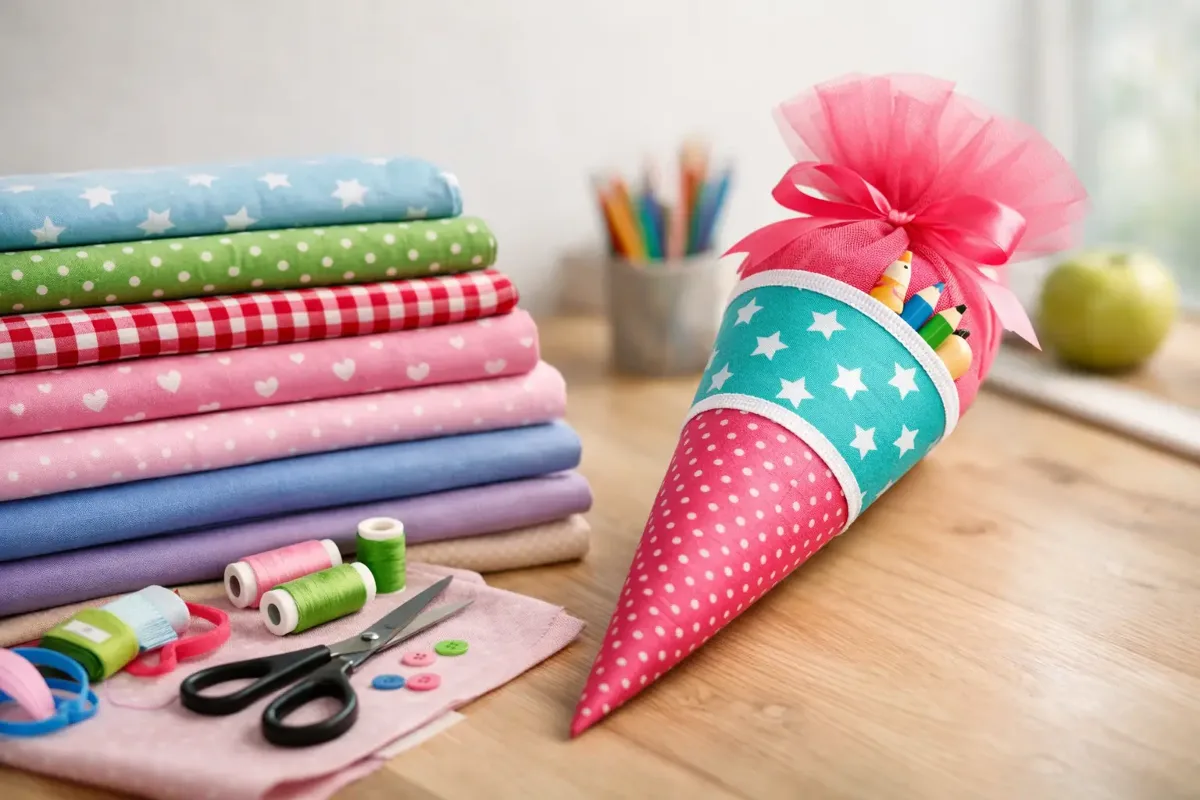
The big day is getting closer, the sewing pattern is ready and waiting, and suddenly the most important question comes up: which fabrics are actually best for a school cone? This is often what decides whether the finished school cone keeps its shape nicely, can be sewn neatly and suits both the child and the occasion. After all, not every fabric that looks lovely on the shelf really works well on a school cone.
Which fabrics really work well for a school cone
When it comes to a school cone, three things matter: the fabric should be easy to work with, have enough body of its own or be easy to reinforce, and suit the style of the project. Especially if you're sewing a school cone for the first time, it's worth choosing not just by motif or colour but also by the properties of the material.
Very soft, drapey fabrics often look pretty, but they can quickly sag or crease once the school cone is filled. Fabrics that are too thick, on the other hand, make sewing curves or the closure unnecessarily difficult. The most pleasant materials to work with are therefore those that are sturdy enough but can still be turned, topstitched and embellished easily.
The best fabrics for a school cone: these materials are especially popular
Woven cotton: the easy-going classic
When customers in the shop ask for a fabric for their first handmade school cone, woven cotton is almost always a good place to start. It can be cut precisely, barely shifts while sewing and is available in countless colours and children's prints. It's particularly rewarding for appliqué, names, ribbons or decorative stitches.
Cotton does have limited body, though. On its own it usually isn't enough for a school cone, so it works best together with interfacing, wadding or a sturdy cone blank. That's not a drawback – quite the opposite. It gives you lots of creative freedom and lets you adjust the firmness exactly as you need.
Canvas for extra stability
Canvas is a very practical choice if you want the school cone to have a bit more body. It's more tightly woven than standard woven cotton and naturally offers more stability. That's especially handy if you don't want the cone to look floppy or if you'd like larger areas without many seams to look neat.
Just bear in mind that not all canvas is the same. Very heavy weights can become rather stiff at the top, where the fabric is gathered or tied. Medium-weight canvas is often the most comfortable option for school cones. It gives support without feeling bulky.
Poplin for fine, crisp results
Poplin is smoother and often slightly finer than ordinary woven cotton. If you'd like to sew a more elegant or detailed school cone, it's a great choice. It works beautifully for clear patterns, lettering and finer designs.
Compared with canvas, poplin usually needs a little more support from interfacing or a cone blank. In return, the surface often looks especially clean and high-quality. If you want the school cone to look playful, modern or delicate, poplin is a lovely option.
Muslin – only with a plan
Muslin is popular because it feels soft and has a relaxed look. For school cones, however, it isn't always the first choice. Its loose structure often lacks the necessary stability, and on heavily patterned or elaborately decorated projects its uneven surface can look a little busy.
That doesn't mean you have to rule muslin out completely. As the fabric cuff at the top, for a bow or for soft, romantic accents, it can look really beautiful. For the main body of the cone, though, it's usually too soft on its own.
Felt for details and appliqué
Felt is rarely the main fabric for a whole school cone, but it's a very useful material for decorations. Letters, stars, animals, vehicles or small themed motifs are easy to cut out and sew on. Especially with children's designs, it quickly adds a loving, handmade feel.
Felt can work for the whole body if it isn't too thick. In that case, though, take a close look at how well it can be sewn and shaped. Many people prefer to use felt as an extra rather than as the base fabric.
Which fabric suits which school cone style?
Not every school cone is meant to look the same, which is exactly why there's no single perfect fabric for every project. For classic school cones with colourful motifs, names and appliqué, woven cotton is usually the easiest choice. For modern, more minimal designs in muted colours, canvas is often a better fit. If you like things light, fine and full of detail, you'll often end up with poplin.
The child's age and the chosen motif play a part too. For a playful school cone with a unicorn, dinosaur or building site theme, the fabric can happily be a bit livelier. For simple designs in natural tones, with stars or personalised embroidery, a calm, sturdy fabric often looks more harmonious.
If you're unsure, one simple question helps: should the school cone look soft and decorative, or stand up sturdy and well shaped? This can often settle the choice of material surprisingly well.
You often can't do without reinforcement
One point is often underestimated when buying fabric: even the best fabrics for a school cone often only show their full potential with the right reinforcement. The fabric rarely has to hold the entire shape on its own. Usually it works together with a cardboard blank or a ready-made school cone blank, plus interfacing, heavyweight pelmet interfacing or wadding, depending on the pattern.
Cotton and poplin almost always benefit from interfacing. Canvas doesn't always need it across the whole piece, but often at least in certain areas. The top edge, appliquéd areas and parts that take a lot of strain in particular will keep their shape better.
If you'd like to sew a school cone that still looks good as a keepsake after the big day, this extra stability is well worth it. The result looks neater, holds its shape more nicely and is usually easier to work with.
These fabrics are only suitable to a limited extent
Some materials look appealing at first glance but can be tricky for school cones. Jersey, for example, is stretchy and therefore harder to sew accurately when stability is needed. Viscose drapes beautifully but is usually too soft and slippery for a school cone. Very thick home décor or upholstery fabrics do have plenty of body, but they can quickly become too cumbersome at seams and curves.
Coated fabrics or faux leather also look exciting but call for some sewing experience. They're less forgiving, can't always be pinned easily and can sometimes look harsher than intended with children's motifs. They're great for individual accents, but as the main fabric they depend on the project and your skill level.
What exactly to look out for when buying
Besides the material itself, it's worth checking three very practical points. First: the fabric width and the cut. You often don't need a huge amount for a school cone, but you should be able to position the motif nicely. With larger prints especially, it's frustrating if your favourite motif ends up half hidden in the seam.
Second: how well the fabrics combine. Many school cones look especially lovely when the main fabric, cuff, ribbon and appliqué all match in colour. It pays to think of your fabrics not individually but as a small overall concept.
Third: how easy the fabric is to sew. If you want a relaxed project, choose a fabric that feeds through the machine well and doesn't fray or shift too much. That saves time, nerves and often a few trips with the seam ripper too.
A good school cone starts with an honest choice of material
Many people want a school cone that not only looks good in photos but is also a pleasure to sew. That's exactly why it's worth choosing the material realistically. The most eye-catching fabric isn't automatically the best – the best one is the fabric that suits your pattern, your style and your sewing level.
If you're sewing for the first time, woven cotton or poplin with suitable reinforcement is usually the safest bet. If you already have some experience and want more body, canvas is a great choice. And if you'd like to add special accents, combine the main fabric with felt, muslin or small contrasting fabrics.
At Die Stoffkönigin, projects like these show time and again that the most beautiful school cone rarely happens by chance – it comes from a well-balanced mix of practical material and loving design. If you let yourself be guided not just by the print but also by how the fabric handles, the big first appearance is already half sewn.
In the end, the school cone should above all be one thing: a little piece of excitement you can hold in your hands – and that's exactly why choosing the fabric deserves a bit more thought than you might expect at first.