Buying fabric for a rain jacket – what to look out for
When you're buying fabric for a rain jacket, colour isn't the only thing that makes a sewing project a success. Far more important is how the jacket will actually be worn: every day on the bike, as a light in-between-seasons jacket for children, or as a weatherproof layer for walks with the dog. That's what decides which fabric really makes sense – and which one looks lovely but doesn't hold up in everyday life.
Buying rain jacket fabric – start by pinning down your project
For their first rain jacket, many people simply reach for the first water-repellent fabric they come across. That's understandable, but it often ends in disappointment. A rain jacket for the school run needs different qualities from a fashionable anorak or a light summer raincoat.
Before you buy, ask yourself some concrete questions: should the jacket be light and pack down small, or warm and sturdy? Will it regularly face heavy rain, or is it more about drizzle and wind? Is it for an adult, a child or a baby? The clearer the purpose, the easier the choice.
With children's jackets in particular, the fabric also has to put up with quite a lot. It should be hard-wearing, allow plenty of movement and ideally not object too much to a bit of mud. For a women's jacket, on the other hand, the drape of the fabric often matters more. A stiff fabric may protect well, but depending on the style it can quickly look a little bulky.
Which fabric is suitable for a rain jacket?
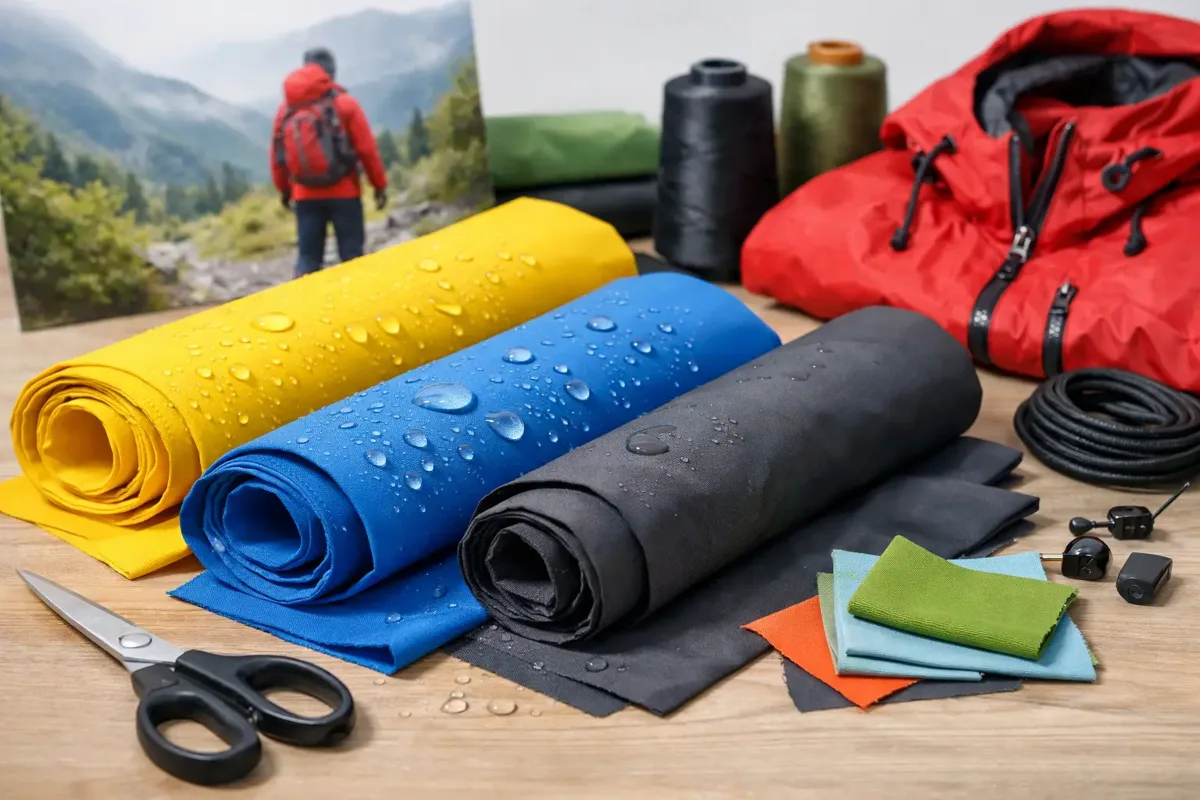
Not every water-repellent fabric automatically makes a good rain jacket fabric. In everyday sewing you'll mainly come across coated fabrics, softshell and special outdoor fabrics by the metre with a membrane or a water-repellent finish.
Coated rain jacket fabrics are often the classic choice when it really comes down to keeping the wet out. They usually have a smooth surface and reliably keep rain off. At the same time, the feel of the fabric matters a great deal here. Some versions are pleasantly soft, others rather firm and rustly. If you want to sew a flowing coat, it's worth reading the fabric description carefully.
Softshell is popular because it's very forgiving and comparatively pleasant to sew. It protects against wind, keeps off light to moderate rain and often comes with a warm inner side already built in. That's handy for late autumn or for children's clothing. In persistent heavy rain, however, softshell reaches its limits sooner than a more heavily coated rain fabric.
Outdoor fabrics with a membrane are often technically very capable, but they're not always the first choice for beginners. They can be thin, light and functional, but they call for a little more care when cutting and sewing. This is where it pays to keep your chosen sewing pattern in mind. A complicated pattern plus a demanding fabric isn't always the most relaxing combination.
Waterproof or water-repellent – the difference matters
In everyday language the two are often mixed up, but for your sewing project the difference counts for a lot. Water-repellent means that droplets initially bead up and roll off. In prolonged or heavy rain, moisture can still get through. Waterproof means the fabric protects much better against the wet.
For a rain jacket that's only needed for a quick dash to the car or to nursery, water-repellent fabric can be perfectly adequate. But if the jacket is really going to be worn out in the rain, it's worth taking a closer look.
It's also important to remember that even a waterproof fabric doesn't make a completely waterproof jacket. The seams are always potential weak spots. If you have very high expectations for keeping dry, look into seam sealing or choose a project where full outdoor performance isn't the main priority. For many hobby sewing projects, a practical, well water-repellent jacket is exactly right.
These are the qualities that really matter when buying
When you're buying fabric for a rain jacket, it's worth looking beyond appearance. The material should suit the pattern, the season and your sewing experience.
Weight is a good first indicator. Lightweight fabrics are suitable for unlined jackets, summer parkas or rain ponchos. Heavier qualities often look more premium and hard-wearing, but they're also bulkier. For small children's sizes, a fabric that's too heavy can quickly become impractical.
The back of the fabric is just as important. A soft, textile back is usually more comfortable to wear than a smooth coating directly against the skin. If the jacket is to be unlined, that makes a big difference. If you're adding a lining anyway, you have more leeway.
Don't underestimate stiffness either. A fabric can be technically excellent and still not suit your pattern. A jacket with gathers, a hood, pocket flaps and a softer drape needs a different material from a simple, straight raincoat.
And then there's care. Especially for children's rainwear, it makes sense to choose easy-care fabric. If a fabric has to be treated very delicately, that's rarely practical in family life.
Buying rain jacket fabric to suit your sewing pattern
Often the fabric is chosen first and a suitable sewing pattern is found afterwards. It's usually easier the other way round. The sewing pattern gives you lots of clues about how soft, stretchy or stable the fabric should be.
A sporty style with a zip, hood and functional details can usually take a somewhat firmer fabric. A simple A-line raincoat, on the other hand, quickly looks boxy in a fabric that's too stiff. For children's jackets, freedom of movement and straightforward construction are especially important. Here, softer but still weatherproof fabrics are often the more comfortable choice.
If you haven't sewn many jackets yet, it's best to pair a clear, straightforward sewing pattern with a fabric that's easy to sew. That saves your nerves and makes it more likely that the finished jacket will actually be worn and loved.
Which notions should you get at the same time?
With a rain jacket project, choosing materials doesn't stop at the outer fabric. Zips, press studs, cords, eyelets and possibly a suitable lining should all be considered from the start. Especially with water-repellent fabrics, you don't want to discover later that the colour is lovely but there's no matching zip available any more.
If the jacket is to have a light lining, smooth lining fabrics or lightweight jerseys work well, depending on the project. For warmer designs, a cosy inner layer can also make sense. Bear in mind: the thicker the lining, the more it changes how the jacket hangs. That should suit the pattern.
It's also practical to make sure buttons and accessories work well together. A rain jacket isn't just about how it looks on the outside – it's about simply working in everyday life.
Common mistakes when buying rain jacket fabric
A common mistake is to be guided only by the colour or print. Of course the jacket should look good in the end. But if the fabric is too stiff, too thin or unsuitable for how you plan to use it, the project often ends up abandoned.
Getting the quantity wrong is just as common. Rain jackets often have larger pattern pieces, hoods, facings or pockets. Check the fabric requirements in the sewing pattern carefully, and with directional prints it's better to allow a little extra.
Some buyers also underestimate how the fabric will sew. Coated fabrics, smooth surfaces or multi-layer materials can behave differently from cotton or jersey. If you plan for that, you'll sew in a more relaxed way. And if you'd like to test first, you'll benefit from small minimum order quantities rather than having to buy too much fabric straight away.
How to buy more wisely and with less stress
It's best to choose rain jacket fabric not just by the label, but with a little project sketch in your head. What should the jacket look like, when will it be worn, does it need warmth, lots of freedom of movement or above all protection from the rain? With these questions in mind, the choice becomes much clearer.
With a well-stocked specialist retailer, it helps if you can compare fabrics by intended use and not just by material name. That's exactly what makes choosing easier, because "water-repellent fabric" suddenly turns into a real decision for a children's jacket, a transitional parka or a light coat. At Die Stoffkönigin, many customers value precisely this practical guidance – along with the option of ordering smaller quantities and planning a project realistically.
If you're unsure, don't think in terms of perfect solutions, but suitable ones. Not every handmade rain jacket needs to be ready for an expedition. Often a fabric that works well for your everyday life, is pleasant to sew and ends up being worn with pleasure is all you need. That's when your fabric purchase has done its job – and fabric by the metre becomes a favourite piece that doesn't stay in the wardrobe on the first rainy day.
Matching categories
Matching products
Rainwear Fabric Fruit in Cream
€7.45per 0.5 m
Unit price €14.90 / m
Softshell in Dusty Pink
€8.45per 0.5 m
Unit price €16.90 / m
Outdoor Fabric Colourful Collection Bullshit Remover Ochre/Lilac by Swafing by Cherry Picking
€9.45per 0.5 m
Unit price €18.90 / m
Rainwear Fabric in Brown/Beige
€7.45per 0.5 m
Unit price €14.90 / m
Softshell in Dark Blue
€8.45per 0.5 m
Unit price €16.90 / m
Outdoor Fabric Colourful Collection Bullshit Remover Mint/Lilac by Swafing by Cherry Picking
€9.45per 0.5 m
Unit price €18.90 / m