How to Measure and Sew a Zip Properly

A zip is quick to buy – and just as quickly the reason why an otherwise lovely sewing project doesn't sit neatly. Too long, too short, the wrong width, unsuitable for the fabric: that's exactly why it's worth taking a closer look at how to measure and sew a zip properly. If you plan carefully here, you'll save yourself frustration at the machine and end up with a fastening that looks good and works reliably day to day.
Measuring and sewing a zip properly – what really matters
The most common mistake is a simple one: many people measure the whole zip from top to bottom. In most cases, though, what counts isn't the total length including the tapes, but the usable length between the top and bottom stops. It's this length that has to match the opening in your sewing project.
So for a cushion cover, skirt or dress, the length of the finished opening is your starting point. Only then do you choose the right type of zip. It sounds obvious, but it makes a big difference. An invisible zip behaves differently from an open-ended jacket zip, and a continuous zip is a topic of its own again.
When you're sewing clothes, the zip shouldn't just close somehow – it also needs to suit the way you move in everyday life. Close-fitting trousers often need a slightly longer opening than a cushion. With a bag, on the other hand, the strength of the coil or teeth matters as well as the length.
Which length is the right one?
First, measure the section that actually needs to open and close. Measure this opening along the seam line, not loosely across the fabric. If you're working from a sewing pattern, the zip length is often given. Even so, it's worth a quick double-check, as seam allowances and your own adjustments can easily change things by a few centimetres.
For skirts and dresses, a good rule of thumb is that the zip length roughly matches the marked slit or opening length on the pattern. For cushion covers, the zip can be a little shorter than the full edge, because you need some fabric at the sides to finish it off. For bags, it depends on how wide you want the opening to be. A very short opening looks tidy but can be impractical in everyday use.
It also matters whether the zip can be shortened. Plastic coil zips can usually be adjusted fairly easily. Metal zips are far less forgiving. Open-ended zips for jackets are best bought in exactly the right length, because the bottom fastening section is fixed by design.
How to measure correctly
Place a tape measure directly along the planned opening. Measure in a straight line and don't add anything for overhanging fabric. On the zip itself, measure the length of the teeth or coil from the top stop to the bottom stop. Don't include the fabric tape.
If you're unsure, measure twice: once on the pattern piece and once on the fabric you've already cut. Especially with soft fabrics such as viscose or jersey, the edge can easily stretch out of shape. Firm fabrics such as canvas or softshell usually hold their shape better, but the zip often needs more body and strength.
The right type of zip for your project
Not every zip suits every fabric, and not every look makes sense for every project. This is the point where beginners often reach for a zip that's roughly right but causes problems when sewing it in.
An invisible zip is ideal for dresses, skirts or fine cushions when you want the fastening to all but disappear. It takes a bit of care to sew in, but the result looks very neat. A standard closed-end zip works well for bags, make-up pouches, cushions or even trousers, if the pattern is designed for it. An open-ended zip belongs on jackets, waistcoats or cardigans with a full-length opening.
Then there are continuous zips. They're especially handy for bags, pouches or custom lengths. You cut the length you need yourself and fit the slider. They're not always the best first choice for clothing, but for accessories they're often wonderfully flexible.
Fabric and zip need to match
A fine zip on heavy bag fabric can quickly look lost. Conversely, a chunky, stiff zip in a lightweight blouse adds unnecessary bulk. With jersey or other stretch fabrics, take particular care to stabilise the edge so the seam doesn't ripple. With coated fabrics or raincoat fabrics, it also matters how the material feeds under the presser foot and whether you might need a suitable special foot.
If you enjoy sewing lots of different projects, you'll soon notice there's no single perfect zip – just the right solution for each job. That's exactly where a well-stocked range pays off, the kind you're more likely to find at a specialist shop than somewhere between standard stock and a lucky find.
Sewing in a zip – preparation makes it neater
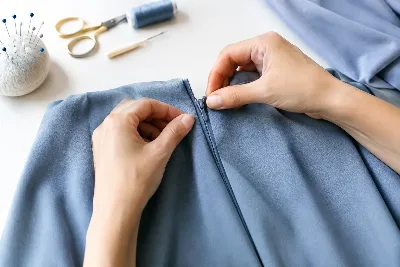
Even the nicest zip won't help much if the preparation is sloppy. First, mark the start and end of the opening. If the fabric allows, press the seam allowances beforehand. With delicate or slippery fabrics, tacking or Wonder Tape helps stop anything shifting while you sew.
With woven fabric, you can often sew a zip in directly and with good control. With stretch fabrics, some form of stabilising is almost always a good idea, such as stay tape or a lightweight interfacing along the opening. Otherwise the edge will pull in as you sew and the zip will ripple.
The needle plays its part too. A finer needle makes sense for delicate fabrics, and a heavier one for sturdy fabrics. This isn't a minor detail. If the needle doesn't suit the material, the look of the seam soon suffers.
Measuring and sewing zips for typical projects
On a cushion, the zip is usually straightforward as long as the length and position are right. A very popular approach is to make the zip a little shorter than the width of the cushion. That keeps the corners stable while still letting you remove the cover easily.
On a skirt or dress, the exact seam line matters much more. Even a small misalignment is noticeable here. So measure precisely to the point where the seam should continue closed. An invisible zip is often the neatest choice here, but it needs the right presser foot or at least a bit of practice.
With bags, it all comes down to how they'll be used. If the bag should open wide, choose a generous length. For small make-up bags or pencil cases, a continuous zip is often handy because you can adjust the length as you like. For bags that get heavy use, the zip should be sturdy enough not to wear out or snag after a short time.
Common mistakes and how to avoid them
A classic mistake is choosing the zip length by eye. This often means the zip is under tension at the ends or the opening can't be fully used. It's better to always start from the project, not from the notion.
Just as common is mixing up the total length and the coil length. So whether you're in a shop or buying online, it's worth checking the product details carefully. If only the zip length is given, it usually means the usable length – but don't rely on that blindly; check the description.
Sewing in a zip without securing it first can also test your patience. What looks straight on the table can easily shift a few millimetres under the machine. On the side of a bag that might be less noticeable, but on the back of a dress it shows straight away.
And then there's the question of looks versus everyday use. A very fine invisible zip looks great, but it isn't designed for heavy strain. For children's clothes, bags or covers that get used a lot, it's sometimes better to go for something a little sturdier. Pretty and practical aren't mutually exclusive – you just need to choose wisely.
When shortening makes sense – and when it doesn't
Shortening zips is handy, but it isn't always the best solution. Closed-end coil zips can often be adjusted well, as long as you work neatly and secure the new end point. That's useful for quick projects, especially when you don't have the exact length to hand.
Shortening makes less sense for open-ended jacket zips or when the material is very chunky and stiff. Here, a makeshift fix can quickly look improvised. If you want a project to look genuinely high quality, it's worth getting exactly the right length.
Especially when you're sewing for children, making gifts or planning a favourite piece, the right zip makes more of a difference in the end than you might think at first. It's what decides whether something is simply finished or truly works well.
A zip doesn't have to be a complicated component. If you measure the opening carefully, choose the right type and take the fabric into account, sewing becomes much more relaxed. And that's exactly how a sewing project should be – doable, neat and with a result you'll enjoy for a long time.