Learning to sew for beginners made easy
Your first seam is often more crooked than you expected. The fabric drifts slightly to the left, the thread tangles, and suddenly the sewing machine seems like a rather complicated piece of kit. That's exactly why it pays to approach learning to sew as a beginner step by step – with simple projects, suitable materials and expectations that stay realistic.
When you start sewing, you don't need a perfectly equipped craft room straight away. A good start matters far more. When the fabric, notions and project all suit each other, that first sense of achievement comes quickly. And that's usually the moment when curiosity turns into a real hobby.
Learning to sew as a beginner doesn't start with the machine
Many beginners think about the sewing machine first. Understandable – without one, there's not much you can do for many projects. Even so, the machine isn't the only thing that decides whether you get off to a good start. A beginner-friendly fabric, a manageable sewing pattern and a project that doesn't overwhelm you at the cutting stage are at least as important.
To begin with, woven cotton fabrics are often a more relaxed choice than very stretchy materials. Cotton is easy to cut, shifts less and is more forgiving of small inaccuracies than jersey or viscose. If you want to sew clothes straight away, you can of course go for jersey – but be aware that stretch fabrics need a bit more feel for the needle, stitch choice and how you guide the fabric.
The same goes for choosing a project: think smaller. A cushion cover, a fabric storage basket, a simple tote bag or a snood are often more sensible than a first handmade dress with a zip and facing. Not because beginners couldn't manage it – but because a quick success keeps you motivated and reinforces the basics along the way.
Your basic kit doesn't have to be big
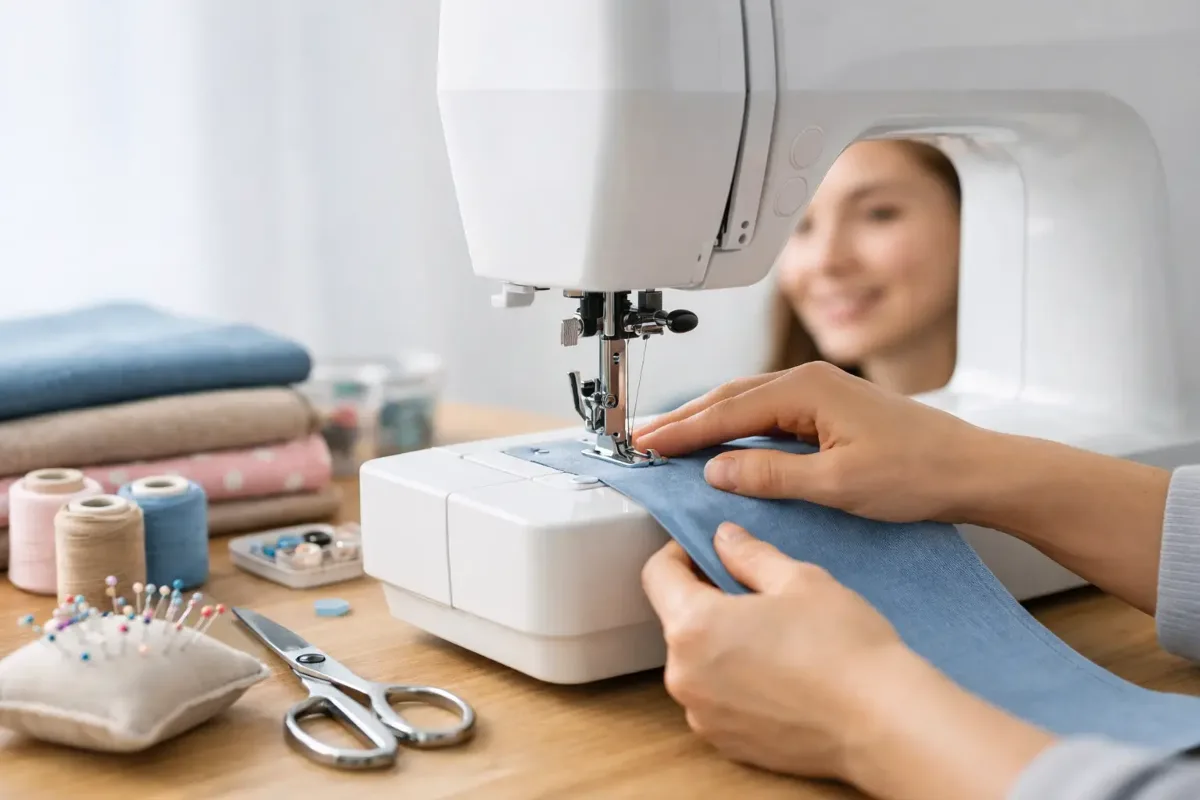
A modest set of tools is enough for learning to sew as a beginner. A reliable sewing machine, fabric scissors, pins or clips, a tape measure, tailor's chalk or a marking pen, a seam ripper and matching thread are usually all you need to start. Add machine needles in the right size and perhaps a small cutting mat if you cut fabric regularly.
When it comes to thread, quality is worth a look. Very cheap thread often sheds more lint, snaps more easily and leads to frustration sooner. The same applies to needles. If stitches are skipped or the fabric looks damaged, the machine isn't always to blame. Often the needle simply doesn't suit the material.
A practical example: for cotton, a universal needle is usually a good choice. For jersey, you'll want a jersey or stretch needle so the knit loops aren't damaged. Softshell, canvas or fleece have different requirements again. Especially at the start, the right combination of fabric, thread and needle saves a surprising number of problems.
Which fabric is really best for beginners?
The honest answer is: it depends on the project. There's no single beginner fabric for everything. If you want to sew home décor, woven cotton fabric, canvas or coated cotton are often a good bet. Jersey is popular for children's clothes or comfy basics, but it takes a bit more practice. Fleece is soft and pleasant, but depending on its thickness it can get bulky when you sew pieces together.
Fabrics that are neither too thin nor too slippery are especially beginner-friendly. That's why pure woven cotton is a classic. It's ideal for cushion covers, drawstring bags, simple totes, placemats or small gift ideas. Poplin can work well too, as long as the project isn't too complicated.
Very drapey fabrics such as viscose or smooth technical materials are often trickier. They look beautiful, but need more precision when cutting and sewing. When you're just starting out, there's no need to make life unnecessarily hard for yourself. A lovely result often comes more quickly with a fabric that's easy to control.
Your first projects should teach you something
A good beginner project isn't just easy. It also introduces a new technique without overwhelming you. A cushion cover trains straight seams and accurate cutting. A fabric basket teaches you how to sew corners. A tote bag shows you how to attach handles and topstitch seams neatly. A snood or simple scarf gets you used to handling longer seams and layers of fabric.
When it comes to clothing, a slouchy beanie, a simple skirt with an elasticated waist or an uncomplicated top is often doable for more confident beginners. A lot depends on how sure you already are when cutting out and reading instructions. If you're sewing for the very first time, accessories are usually the more relaxed option.
Sewing patterns can be simple. A few pieces, clear markings and a logical order of steps help more than lots of variations. If you're using a PDF sewing pattern, it should be printed accurately and carefully taped together. Otherwise even small inaccuracies carry straight through to the finished piece.
Common beginner mistakes – and what really helps
The most common mistake isn't a crooked seam. It's speed. Many people press the foot pedal down too hard, push or pull the fabric too firmly, or want to get a step over with quickly. Sewing gets easier when you slow down. The machine feeds the fabric itself – your job is to guide it, not pull it.
A second classic is inaccurate cutting. If your fabric pieces aren't prepared neatly, sewing them together becomes unnecessarily difficult. So it's worth investing a few extra minutes in cutting before the first stitch. Straightening edges, following the grainline, transferring markings – it sounds unexciting, but it makes a big difference.
Beginners also tend to underestimate pressing. Yet many seams only look tidy once they've been pressed. If you press seams open or pre-shape edges with the iron, you'll work more neatly and often find the next steps easier too. Sewing and pressing go together more closely than it seems at first.
Learning to sew as a beginner also means reading instructions properly
Many problems don't happen at the machine but before you even get there. If terms like right side of the fabric, seam allowance, fold or finishing raw edges are unclear, even a simple project can quickly become confusing. It's worth deliberately learning these basic terms once. After that, instructions are much easier to follow.
It also helps to read through a sewing pattern completely before you start cutting. Which pieces do you need, which type of fabric is recommended, which notions are required? Is seam allowance included, or do you need to add it? Clearing up questions like these beforehand saves fabric, time and nerves.
Beginners in particular benefit from choosing materials to suit the project. If the instructions call for jersey with ribbing, using a non-stretch cotton won't automatically make it easier. Equally, a stiff canvas isn't ideal if you want to sew a loose, flowing dress. The material influences the result more than many people expect at first.
Why good advice is so valuable when you're starting out
Whether you buy fabric online or in a shop, you'll soon see that the choice is huge. Not all cotton is the same, and not all jersey is the same either. Weight, handle, stretch and intended use all play a part in whether a project succeeds. That's why good advice is especially helpful for beginners.
If you're still unsure, start with small quantities for a manageable project. That takes the pressure off and makes it easier to try out materials. This is exactly what many customers appreciate about a specialist retailer like Die Stoffkönigin: you get not just choice but guidance too – for example on which fabric really suits a pair of children's trousers, a bag or your first jersey top.
It's also handy when notions and sewing patterns are considered right from the start. Thread in a matching colour, the right needle size, perhaps ribbing or interfacing – all of these often only become important when something's missing halfway through a project. A well-planned shop makes getting started much more relaxed.
How to stay motivated
Not every first project looks like the photo on the sewing pattern. That's normal. Sewing is a craft, and craft thrives on repetition. A wonky edge, a twisted layer of fabric or a seam you've had to unpick aren't signs that you're not cut out for it. They're simply part of the process.
Motivation is most likely to last when your projects fit into everyday life. A lunch bag for school, a cushion for the children's room, a simple drawstring PE bag or a gift bag for birthdays all have a clear purpose and can often be sewn in stages. That way you don't just gain practice – you also make something that actually gets used.
With every seam, your feel for fabric, machine and order of work grows. At some point you'll automatically reach for the right fabric quality, instantly recognise how difficult a sewing pattern is and solve small problems as a matter of course. Until then, nothing has to be perfect. It's enough to just start – with a project that suits you and with fabrics that make getting started easier.
If you're feeling unsure about your next sewing project, don't choose the most spectacular one – choose the one that feels right. That's often exactly where the joy of making things yourself begins.