A Guide to Sewing Machine Needles for Different Fabrics
A neat stitch often doesn't start with the fabric, or even the thread, but with a small decision that tends to be made in passing: choosing the right sewing machine needle. That's exactly why a guide to needles for different fabrics is so useful, because many common sewing problems aren't caused by the machine at all, but by the wrong needle.
If you've ever had skipped stitches on jersey, puckered seams on viscose or unsightly holes in coated fabric, you'll know what we mean. The needle has to suit the material - in its point, its size and sometimes its type, too. That sounds more technical than it is in everyday sewing. With a few clear ground rules, choosing becomes much easier.
Why the right needle makes such a difference
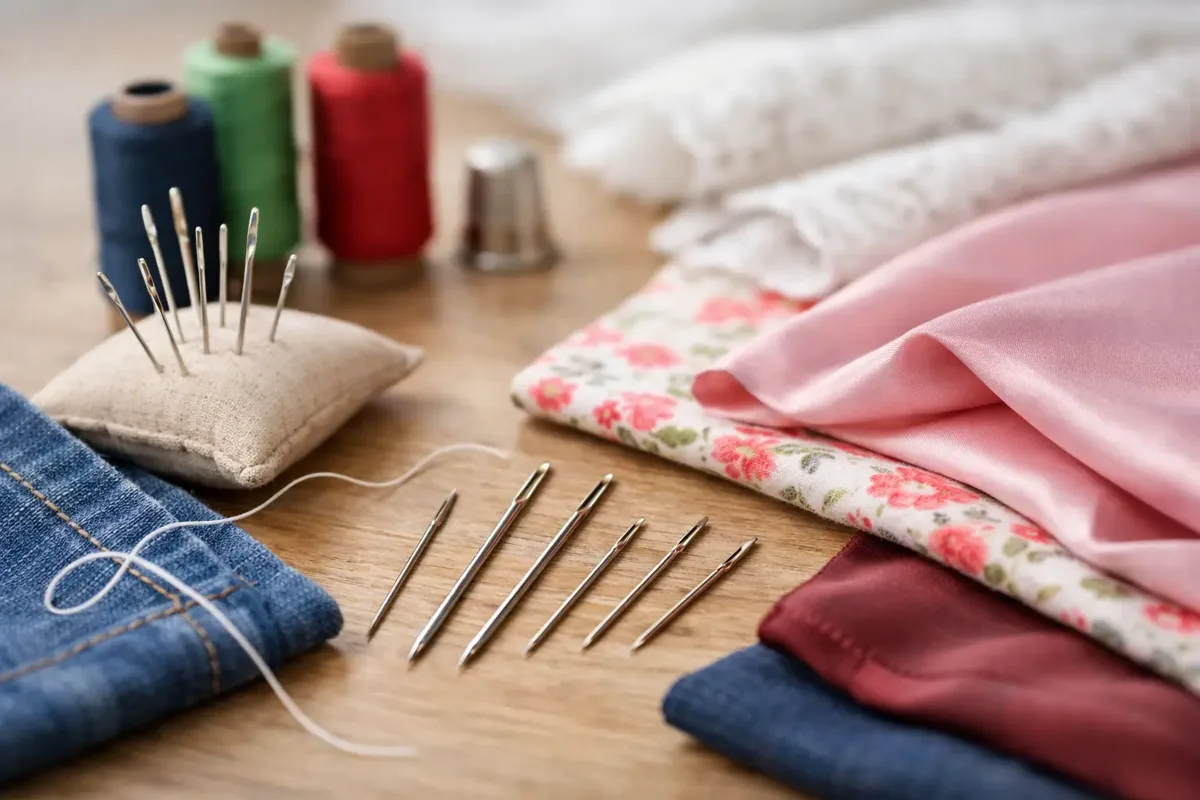
Sewing machine needles look much the same at first glance, but they work very differently. What matters most is the shape of the point, the size and how the needle is made. A fine universal needle can sew woven fabric beautifully and still struggle with stretchy jersey. A jersey needle is gentle on knits, but isn't always the best choice for tightly woven canvas.
When needle and fabric don't match, your machine soon lets you know. You get skipped stitches, the thread snaps more often, the fabric ripples or ends up with visible needle holes. With delicate or stretchy materials in particular, it's worth taking a moment to swap needles rather than carrying on with whichever one happens to be in the machine.
Choosing needles for different fabrics: what matters
In practice, you can work from three questions. Is the fabric fine or thick? Is it woven or knitted? And does it have a special surface, such as a coating, a pile or a very dense weave? The answers will usually point you to the right type of needle.
Needle size is given in numbers such as 70, 80, 90 or 100. As a rule, the finer the fabric, the finer the needle should be. For blouse fabrics, lightweight cotton or viscose, 60 to 70 is often right. For standard woven cotton, poplin and many dressmaking fabrics, 80 is a good all-rounder. For denim, canvas, softshell or several layers, go for 90 to 100. Very thick materials sometimes need an even heavier needle, but for home sewing this range will usually cover you well.
When it comes to the point: woven fabrics generally cope well with a regular, slightly sharp point. Knits need a rounded point so that the fibres aren't damaged. That's why jersey and stretch needles are so important for stretchy fabrics.
Which needle suits which fabric
Cotton, poplin and woven fabrics
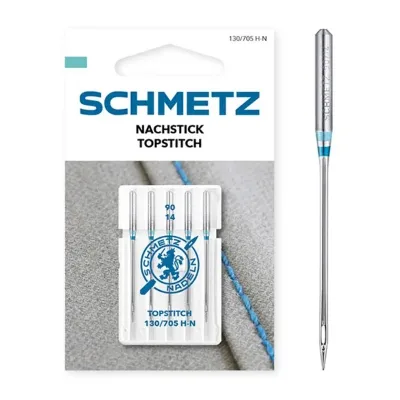
For classic cotton fabrics, a universal needle is often the right choice. For standard woven fabric, size 80 works very well in many cases. If the fabric is finer, such as batiste or lightweight blouse cotton, you're better off with a 70. For sturdier fabric, such as canvas or several layers of cotton with wadding, a 90 is a good choice.
Universal needles are so popular because they cover lots of everyday projects - from cushion covers and bag linings to lightweight garments. Even so, they can't do everything. As soon as the fabric is stretchy or particularly dense, it's worth switching to a specialist needle.
Jersey, ribbing and other knits
Jersey should be sewn with a jersey needle or a stretch needle. The difference sounds small, but it often makes a big difference to the seam. Jersey needles have a ballpoint tip that pushes the loops aside rather than piercing them. This reduces skipped stitches and stops little holes from forming.
For basic cotton jersey, size 70 or 80 is usually right. Ribbing or stretchier fabrics often benefit from a stretch needle, especially if your machine skips stitches on very stretchy sections. Remember: if your first choice doesn't sew cleanly, you haven't done anything wrong. It's often simply down to the shape of the needle.
Viscose, fine fabrics and delicate materials
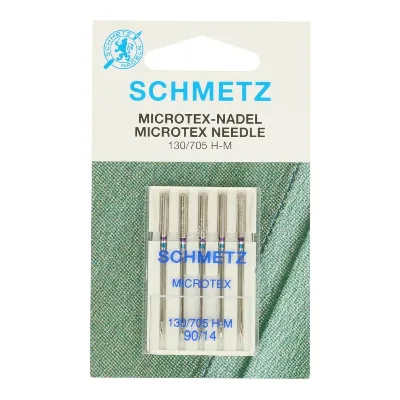
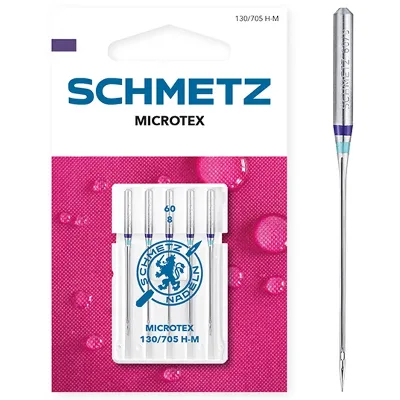
Viscose drapes beautifully but can be a little tricky to sew. Needles that are too thick quickly leave visible holes or cause the fabric to pucker. That's why fine universal or Microtex needles in size 60 to 70 are often the better option.
Microtex needles are generally well suited to fine, tightly woven or smooth fabrics. They can also give neat results on fine cotton, satin or very smooth surfaces. The downside: they're usually not a good idea for knits, because their sharper point can damage the material.
Denim, canvas and heavy fabrics
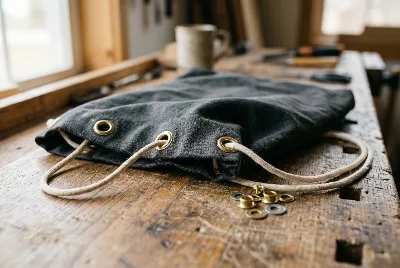
Thick woven fabrics need stability. For denim, canvas or sturdy bag fabrics, jeans needles make sense, usually in size 90 or 100. They're designed to sew cleanly even through dense weaves and where seams cross.
If you use a universal needle that's too fine here, you'll soon hit its limits. The needle can bend, stitches get skipped or the thread suffers. Especially for bags, aprons, cushions or jackets made from heavy material, the right needle saves a lot of frustration.
Softshell, waterproof and coated fabrics
With softshell or coated fabrics, it all depends on the exact structure of the material. Many softshells sew well with a universal or jeans needle in size 80 to 90. If the material is very dense or you're sewing several layers, a heavier needle is often more comfortable.
Coated fabrics are sensitive to unnecessarily large needle holes, because the holes can stay visible. Here, choose a needle that's as fine as possible and only as heavy as necessary. Testing on a scrap is particularly worthwhile with fabrics like these. The same goes for raincoat fabrics, where every needle mark can matter later on.
Fleece, sweatshirt fabric and thick dressmaking fabrics
Fleece is soft, but not automatically difficult. A universal needle in 80 or 90 usually works well. With sweatshirt fabric or brushed fabrics, it depends on how stretchy they are. If the fabric is stretchy, you'll usually get on better with jersey or stretch needles. If it's more stable and thick, a heavier universal needle may be enough.
This shows nicely that it's not just about the name of the fabric. A thin French terry often needs a different needle from a very dense winter sweatshirt fabric.
Common mistakes when choosing a needle
Many sewing problems look similar but have different causes. If stitches are skipped on jersey, the wrong type of needle is often to blame. If the fabric snags or shows small holes, the needle is usually too sharp or too thick. If the machine sounds loud or the seam keeps stalling, the needle may be blunt, bent or unsuitable for the thickness of the fabric.
A fresh needle isn't a minor detail either - it's part of getting a neat result. If you sew several projects back to back, you probably don't change needles often enough. Needles go blunt faster than you'd think, especially on heavy fabrics. If your seams suddenly get worse, swapping the needle is almost always worth trying before any bigger troubleshooting.
How to find the right needle if you're unsure
If you're unsure, don't start with theory - start with how the fabric feels. Handle it and ask yourself: is it soft and stretchy, fine and fluid, or firm and compact? Based on that, choose the needle type first and then the size. For many projects, that's the simplest approach.
A handy rule of thumb: stretchy means jersey or stretch, fine means 60 to 70, normal means 80, heavy means 90 and up. It's no substitute for really knowing your fabric, but in most cases it will get you very close to the right answer. If you regularly sew different materials, it pays to keep a small selection of needles in your sewing kit rather than just one standard type.
Especially if you sew a wide mix of projects - from T-shirts and children's trousers to bags - a well-stocked selection is worth having. At Die Stoffkönigin, we often see that simply combining the right fabric, a suitable needle and a sensible thread weight turns a stalled project back into a relaxed one.
When it's not just the needle
However helpful this guide to needles for different fabrics may be, sometimes the needle is only part of the solution. With stretchy fabrics the stitch matters too, with thick layers the presser foot pressure, and with slippery fabrics adjusting your speed often helps. So if your seam still isn't looking good despite the right needle, it's worth looking at how everything works together.
Even so, the needle remains the quickest thing to adjust. It's inexpensive, quick to change and often has a bigger effect than many of the settings on your machine. Get into this little habit and you'll sew more neatly, be kinder to your materials and have far fewer failed attempts.
In the end, the best needle isn't the one that can do the most, but the one that's exactly right for your fabric - and that usually makes sewing easier straight away.
Matching categories
Matching products
Machine Needles
€3.90per piece
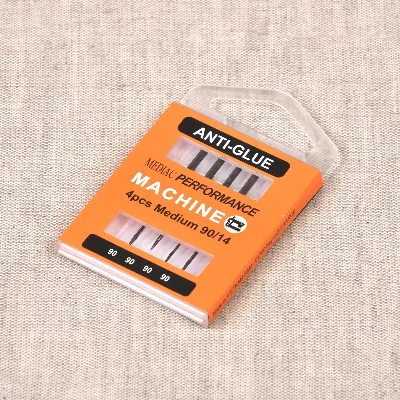
Machine Needles Anti-Glue 90/14, 4 pieces
€5.90per piece
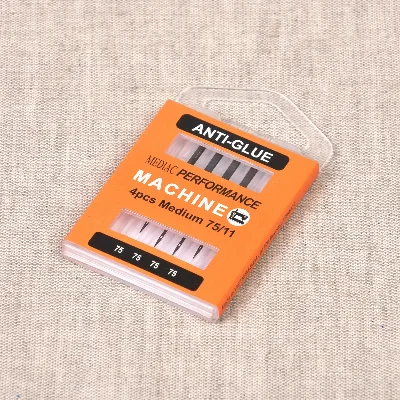
Machine Needles Anti-Glue 75/11, 4 pieces
€5.90per piece
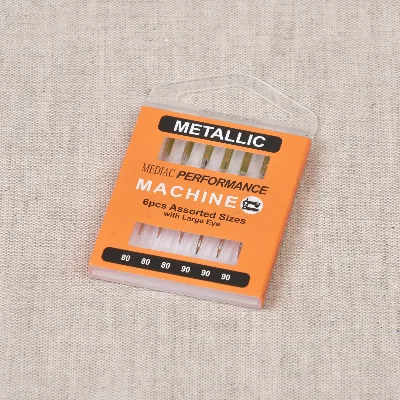
Machine Needles Metallic, assorted, 6 pieces
€4.90per piece
Schmetz Microtex Machine Needles 60
€3.90per piece
Machine Needles
€4.90per piece