Choosing the right softshell fabric for a children's jacket
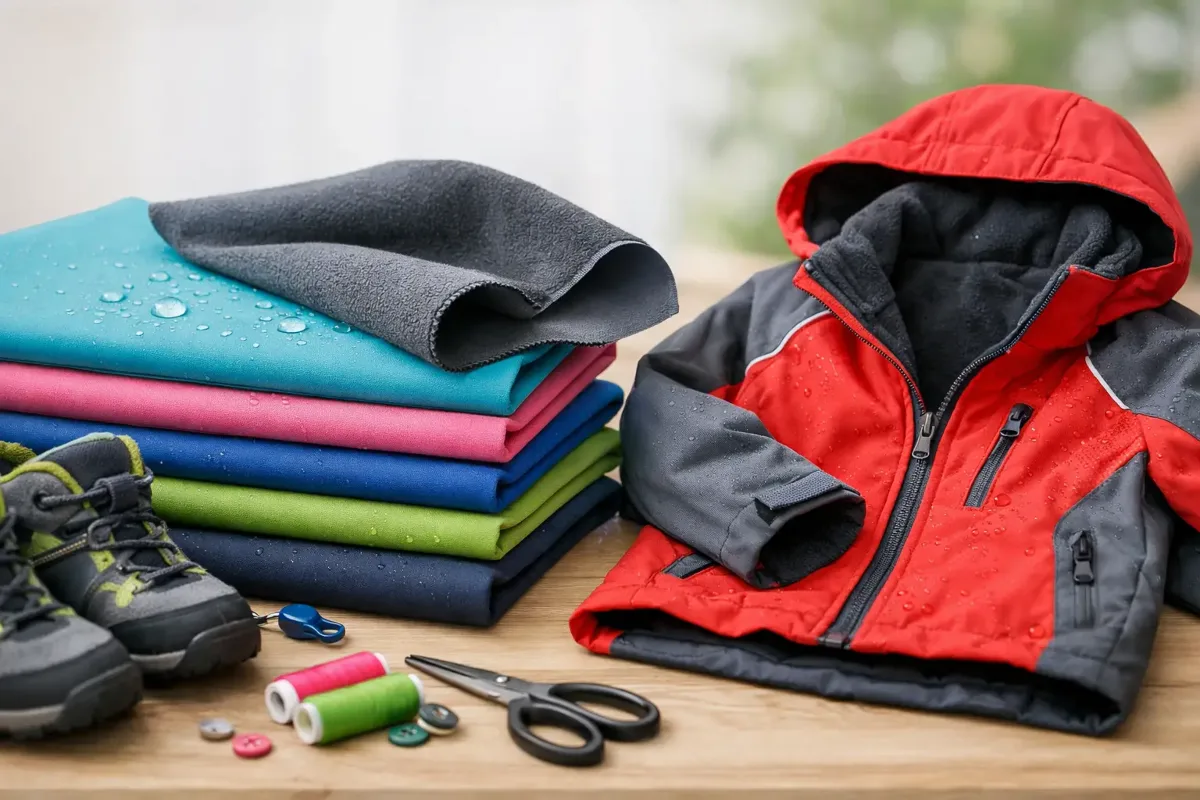
Mud at the playground, wind on the way to school, a quick shower during a walk – these are exactly the moments that show whether you picked the right softshell fabric for a children's jacket. A kids' jacket has to put up with a lot: it should be comfortable, protect them outdoors, look good and not test your patience at the sewing machine.
That's why softshell is so popular for handmade children's clothing. It combines a weather-resistant outer face with a soft inner side, making it a very practical choice for lots of transitional jackets, outdoor jackets and gilets. At the same time, there are differences worth knowing about before you start cutting. Not every softshell suits every sewing pattern, and not every jacket needs to be as thick or as technical as possible.
Why softshell fabric is so popular for children's jackets
Softshell is appealing for kids' jackets mainly because it brings several qualities together in one fabric. The outside is usually smooth and water-repellent, while the inside is often softly brushed or backed with fleece. On many sewing projects this saves you an extra lining and still makes the jacket comfortable to wear.
For parents and grandparents, what really counts day to day is that the jacket is easy. Children can pull it on quickly, move freely and stay well protected from wind or light rain. If you love to sew, there's another bonus: many softshell qualities hold their shape, barely fray and are easy to sew with a little preparation.
Even so, softshell isn't a fabric for everything. In heavy, persistent rain it generally won't replace a proper rain jacket with taped seams. And for the depths of winter a classic softshell jacket is usually too light unless you deliberately plan it to be very warm. Weighing up exactly these points is what makes the difference with children's clothing.
Which softshell fabric suits your children's jacket project?
The key question isn't just whether to use softshell, but which one. For a light transitional jacket, a classic medium-weight softshell with a soft inner side is often all you need. It keeps the wind out well, shrugs off short showers and is a reliable companion for nursery, school and playtime.
If the jacket is meant more for cooler days, it's worth looking at heavier qualities. These often feel a little sturdier and warmer, but can also come out bulkier on patterns designed for lots of movement. For little ones who run, climb and sit a lot, freedom of movement is often more important than maximum thickness.
The pattern plays a part too. A slimmer-cut parka needs a softshell that isn't too stiff. A loose-fitting pixie-hood jacket or a simple hoodie pattern can often cope with a bit more body. If you're unsure, it pays to think about how the fabric behaves together with the style you've planned, rather than deciding on colour or print alone.
The inner side makes a big difference
Many customers look at the design on the outside first. Understandably so – especially on children's jackets, colours and prints should be fun. For comfort, though, the reverse side is at least as important.
A softly brushed, fleece-like backing feels lovely against the skin and instantly makes the jacket cosier. That's ideal for transitional jackets worn without an extra lining. A smoother inner side can make sense if the jacket is going to sit over several layers and needs to slip on and off easily.
Don't think too thick
More fabric often sounds like more protection. In practice, though, a very thick jacket isn't automatically the better one. Children move about a lot, and a jacket that's too heavy or stiff soon ends up left in the wardrobe. For many projects, a medium-weight softshell is therefore the most practical everyday compromise.
What to look out for when buying
If you're buying softshell fabric for a children's jacket, don't just look at the print. What really matters is the handle, the intended use and how the fabric sews. For a jacket that will be worn regularly, the fabric should be hard-wearing without feeling rigid.
Water-repellent doesn't automatically mean waterproof. For normal autumn days, windy afternoons at the playground or the walk to school, that's usually perfectly sufficient. If the jacket is meant for longer rainy days, however, plan realistically or work specifically with rain jacket fabric.
Another practical point is that softshell can often be planned in small quantities. Especially for children's sizes, you don't always need a lot of fabric. That's handy if you want to combine colours, add panel seams or test a new sewing pattern first.
How to sew it without the frustration
Softshell looks technical at first glance, but it's very manageable to sew. The main thing is to bear a few of its quirks in mind. Because the fabric can show needle holes, it pays to work neatly from the start. Unpicking too often quickly leaves marks.
A universal or microtex needle can work well, depending on the fabric quality. What matters is that the needle passes cleanly through the material without causing unsightly skipped stitches. It's best to test your settings on a scrap before you start on the cut pieces.
When holding pieces together, less is more. Lots of pins can leave holes, so fabric clips are often the better choice. The same goes for pressing: work carefully and use heat very sparingly. Softshell doesn't like rough treatment.
Which seams make sense
On children's jackets, seams above all need to be durable. A slightly longer stitch length usually looks nicer on softshell than very small stitches. Areas under a lot of strain, such as armholes, hoods or pocket openings, can be reinforced as well if the pattern allows for it.
Finishing raw edges is often barely necessary, as softshell doesn't fray in the usual way. That makes it pleasant to sew, especially for beginners. Even so, seam allowances should be trimmed neatly so the jacket doesn't get unnecessarily bulky where layers meet.
Zips, ribbing and more
A children's jacket often stands or falls on its details. A zip should run smoothly and suit the weight of the fabric. Too fine and it looks lost; too chunky and it can make small sizes needlessly stiff.
Ribbing at the cuffs or hem can be a good idea if the jacket should fit snugly and keep draughts out. It works well on very sporty styles. If you're sewing more of a classic outdoor jacket, bound hems or simple edge finishes are often the better solution. Here too, it depends on the pattern, the child's age and everyday life.
Which designs are practical for children's jackets
Of course a children's jacket can look lovely. In everyday life, though, you soon find out which colours are genuinely easy-care. Very pale shades look fresh but show mud and wear more quickly. Darker colours or printed softshells are often more forgiving if the jacket regularly ends up on the ground or scrapes along tree bark.
Animal prints, vehicles, flowers, small patterns and easy-to-combine plains are all popular. Especially practical are fabrics that can be paired with a second colour for the hood, pockets or piping. That gives the jacket an individual look without it seeming too busy.
If you're sewing for siblings or want to use a pattern several times, it's worth considering timeless colours. Petrol, berry, navy, sage or rust feel child-friendly without dating too quickly. Combinations like these often last longer than a very trendy print that's lost its appeal after one season.
Care in everyday family life
A children's jacket needs to be washable and fuss-free. Softshell is pleasantly easy-care here, as long as you follow a few rules. It's best washed on a gentle cycle without fabric softener so the water-repellent surface doesn't suffer unnecessarily. High temperatures aren't a good idea either.
Day to day, it's often enough to wipe off light dirt or give the jacket a quick airing. That's especially handy when it's a favourite that's constantly being worn. After many washes the water-repellent effect may wear off – that's normal and not a sign of poor quality.
Who softshell is especially worthwhile for
If you want to sew a jacket that sits somewhere between a rain jacket and a sweat jacket, softshell is an excellent choice. It's particularly suited to children who spend a lot of time outdoors and need a practical in-between-seasons solution. It can also be an interesting fabric for gilets, lightweight puddle trousers or outdoor overalls.
Softshell is less suitable if the jacket should drape very softly, is planned with a heavy lining or is meant to look more like a coat than outdoor wear. In that case, other fabrics often work better. Choosing well doesn't mean always reaching for the most versatile fabric, but for the one that suits the project.
That's exactly what makes sewing so rewarding: you can tailor the children's jacket precisely to everyday life, the season and the child. And if you choose a quality that sews nicely, fits comfortably and really works in family life, a piece of fabric soon becomes a true favourite. At Die Stoffkönigin, we pay close attention to exactly this mix of a lovely selection, fair prices and fabrics that prove themselves in everyday sewing.
In the end, what counts isn't whether the jacket sounds as technical as possible, but whether it gets worn happily – on the way to nursery, on a bike ride or with a treasure from the woods tucked in the pocket.
Matching categories
Matching products
Softshell in Dusty Pink
€8.45per 0.5 m
Unit price €16.90 / m
Rainwear Fabric Fruit in Cream
€7.45per 0.5 m
Unit price €14.90 / m
Softshell in Dark Blue
€8.45per 0.5 m
Unit price €16.90 / m
Rainwear Fabric in Brown/Beige
€7.45per 0.5 m
Unit price €14.90 / m
Softshell Flowers in Dark Blue
€8.45per 0.5 m
Unit price €16.90 / m
Rainwear Fabric in Grey
€6.45per 0.5 m
Unit price €12.90 / m