Which needle is really right for denim?
Denim is not a forgiving fabric. If the needle isn't right, you'll notice straight away: skipped stitches, cracking noises, wonky seams or, at worst, a broken needle. That's exactly why the question ‘which needle for denim?’ is no small matter. It's often the difference between a neatly sewn result and a rather frustrating one.
Which needle is right for denim?
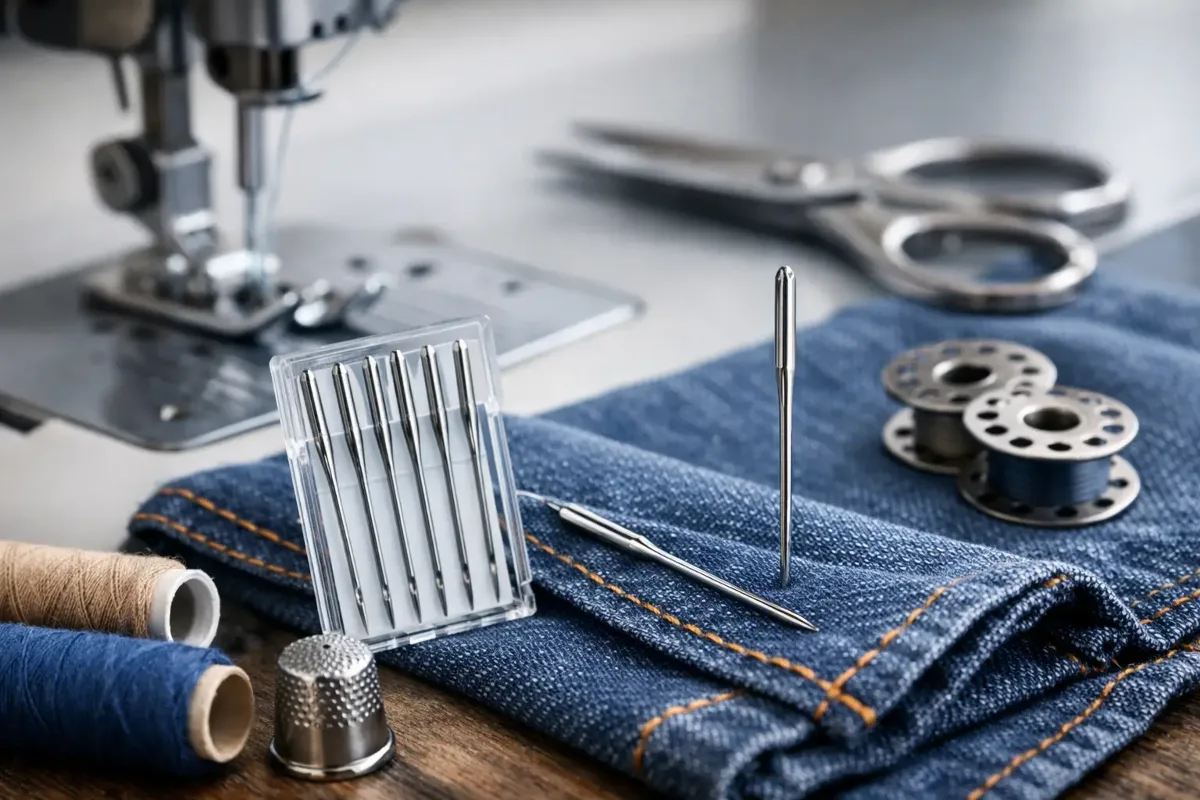
For classic denim, a jeans needle is the best choice in most cases. It's more robustly built than a universal needle and pierces densely woven, sturdy fabrics more easily. You'll notice the difference quickly, especially on trousers, jackets, bags or heavy furnishing denim.
The most common sizes are 90, 100 and 110. Which size makes sense depends on how heavy and dense the fabric actually is. Not all denim is the same. Lightweight summer denim behaves very differently from stiff raw denim or fabric with several thick layers at flat-felled seams and hems.
So if you're wondering which needle suits your denim, this rule of thumb helps: for lightweight denim, a size 90 is usually enough; for standard trouser denim, 100 is often the safe choice; and for very heavy denim or lots of layers, you're better off reaching for a 110.
Why a jeans needle can do more than a universal needle
A universal needle works well for lots of projects, but with denim only up to a point. As soon as the fabric gets denser or several layers come together, the strain increases considerably. A jeans needle is designed for exactly that. Its shank is especially sturdy, so it bends less as it sews through tough fabrics.
That might sound like a minor detail, but in practice it makes a big difference. If the needle flexes too much, it doesn't catch the thread cleanly and stitches are skipped or become uneven. Side seams, belt loops and thick hems in particular quickly reveal whether the needle is up to the job.
Even so, the thickest needle isn't automatically the best. A needle that's too heavy can leave unnecessarily large holes in lighter denim. If you want neat results, choose a needle as fine as possible and only as strong as necessary.
How to choose the needle size for your fabric and project
Lightweight denim for shirts, dresses or children's clothes is often very easy to sew with a size 90 jeans needle. The fabric is usually softer, sometimes with a little give, and doesn't need extreme strength. Here it's more about getting cleanly through the weave without putting unnecessary stress on the fabric.
For classic trouser denim, a size 100 jeans needle is the best starting point for many sewing machines. It's strong enough for sturdy seams without being oversized. If you're unsure, this is often the most sensible size to start with.
Very stiff denim, bag fabrics with a denim look or projects with lots of seam intersections often call for a size 110 needle. This is especially true if you're also using thicker thread or the machine has to sew over several layers. Here, stability is what counts.
A quick practical tip: always test on a scrap with exactly the same layers of fabric that will appear in your project. A seam through two layers may run perfectly, while the same settings cause problems at a thick intersection.
It's not just the fabric – the thread plays a part too
If you're asking which needle you need for denim, don't forget the thread. Standard all-purpose thread usually runs without any trouble through a size 90 or 100 jeans needle. But as soon as you want to use visible decorative thread or classic jeans thread, the needle needs enough room for the thread to pass smoothly through the eye.
If the needle is too fine for the thread, you'll quickly get thread breaks, an uneven stitch pattern or tension problems. This is often wrongly blamed on the machine, when actually the needle and thread simply aren't a good match.
For thick topstitching thread, a topstitch needle can therefore be a sensible alternative. It has a larger eye and is often more pleasant to use for decorative seams with heavier thread. For the actual construction seams in sturdy denim, though, the jeans needle usually remains the more reliable choice. So it comes down to whether you're prioritising strength, looks or both at once.
When a stretch or jersey needle is better
Not all denim is made purely of cotton. Many modern denims contain elastane, which makes them noticeably stretchier. This applies especially to fabrics for comfy trousers, skirts or children's clothes. A classic jeans needle may work here, but it isn't always the best solution.
With very stretchy denim, a stretch needle is sometimes the better choice because it reduces skipped stitches on stretchy materials. This is particularly true for close-fitting seams that will be under strain later on. So if your denim behaves more like a stretch fabric, it's worth sewing a test piece with both options.
This is exactly where it becomes clear that there's no single answer to the question ‘which needle for denim?’. With rigid, dense weaves, the jeans needle usually wins. With noticeably stretchy denim, a stretch or jersey needle may give a better stitch.
Common problems – and what's really behind them
If your machine stutters on denim, it isn't always just down to the needle size. Often several factors are at play. A blunt needle is one of the most common causes of skipped stitches and messy seams. Even a good jeans needle won't help much if it's already got a few tough projects behind it.
The presser foot and your sewing speed also make a big difference. Don't sew over thick seam areas at full throttle. Slow, controlled sewing takes the strain off the machine, needle and thread. If the fabric rises steeply in front of the foot, it often helps to level the foot so the machine feeds more evenly.
Sometimes the needle is right, but the machine simply can't cope cleanly with the amount of fabric at certain points. Then it's worth trimming seam allowances, hammering transitions flatter or deliberately reducing bulk at tricky spots. Not every domestic machine is happy sewing through eight layers of denim – and that's not user error.
Which needle for topstitching denim?
Visible topstitching is often simply part of the look with jeans. For it to look nice and even, you need not only suitable thread but also a needle that works both visually and technically. For subtle topstitching on lighter denim, the same jeans needle you sewed with is often enough.
For the typical bold jeans look with heavier topstitching thread, a topstitch needle is often more pleasant to use. It protects the thicker thread better and tends to give a neater seam. If your machine plays up with jeans thread in the needle but runs well with normal bobbin thread, that's a classic case for this type of needle.
So you don't need to stick rigidly to one needle type. Many lovely denim projects come about precisely because different needles are used for construction seams and topstitching.
A practical guide for everyday sewing
If you want to keep the decision as simple as possible, this overview helps: for lightweight denim, start with a size 90 jeans needle; for standard trouser fabric, a 100; and for very stiff fabric or lots of thick layers, a 110. For stretch denim, also try a stretch needle. And for decorative topstitching with thick thread, a topstitch needle may be the better choice.
More important than any chart, though, is a quick test before you cut out. Sew a few centimetres, ideally with your actual thread and several layers. If the seam looks neat, the machine runs smoothly and the thread stays intact, you're on the right track. If not, changing the needle often saves more frustration than endless fiddling with the settings.
When you sew regularly with fabrics of different qualities, it makes sense to keep a small selection of needles to hand. That way you can adapt as needed, rather than pushing through a whole project with a solution that only half fits. At Die Stoffkönigin, that's exactly the idea behind good advice: not just any old accessory, but what really moves your project forward.
In the end, denim isn't rocket science – but it does reward good tools. When needle, thread and fabric work together, even a more demanding denim project becomes much more relaxing to sew.