Which thread is really right for your overlocker?
The seam looks wavy, the fabric gets chewed up at the edge, or the machine starts playing up after just a few centimetres. Often it isn't the overlocker itself that's to blame, but simply the wrong thread. That's exactly why the question of which thread to use in an overlocker comes up again and again. The good news: you don't need any secret knowledge, just a feel for what your fabric, your project and your machine really need.
Which overlocker thread is the best choice for everyday sewing?
For most sewing projects, a good polyester overlocker thread is the safest and most straightforward option. It's strong, runs smoothly through the machine and moves well with stretch fabrics. Whether you're sewing jersey, making children's clothes or finishing sweatshirts, leggings or underwear, it will see you through in the vast majority of cases.
What really matters is less a fancy spool than the quality of the thread. A cheap jumbo cone can be tempting, but it doesn't always come with neat winding, an even thickness or low lint. Overlockers in particular are more sensitive to this than ordinary sewing machines. If the thread unwinds unevenly, you constantly have to readjust the tension or fluff builds up heavily, it's almost always worth switching to neatly wound branded thread.
Polyester has a practical advantage when it comes to overlocking: it's hard-wearing and flexible at the same time. Cotton thread may feel more natural, but it's often the less rewarding choice for seams that take a lot of strain or need to stretch. Polyester really comes into its own on clothing that is moved, stretched and washed a lot.
Not every thread is automatically suitable for an overlocker
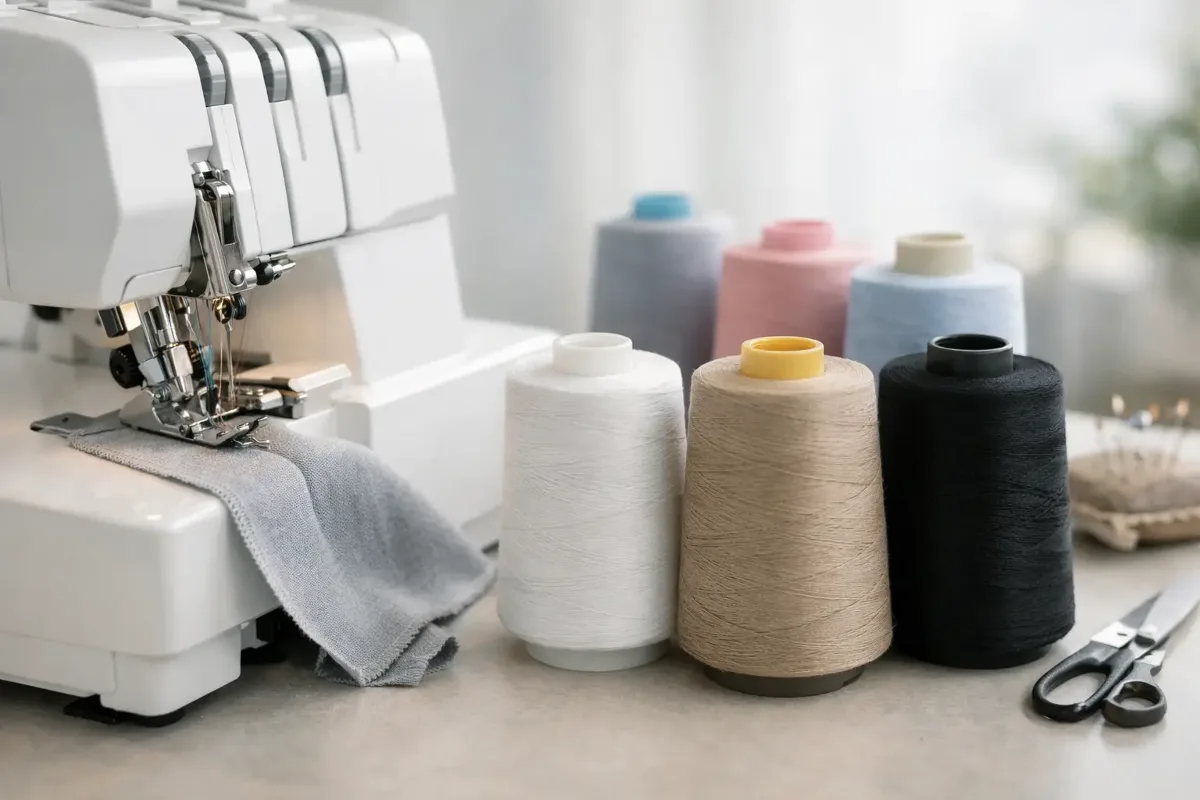
Lots of beginners simply use whatever sewing thread is already sitting next to the machine. That sometimes works, but not always well. Standard sewing machine thread on small reels is usually thicker and runs out much faster. As an overlocker works with several threads at once, large cones or overlocker spools make far more sense for everyday use.
The surface of the thread matters too. Overlocker thread should run evenly and smoothly. Fluffy, uneven or very linty threads may look harmless at first glance, but they can lead to skipped stitches, irregular loops or a lot of unnecessary cleaning. That doesn't mean speciality threads are off limits – just that they aren't the standard solution for every project.
Thread weight: better too fine than too thick
An overlocker produces neater results when the thread isn't too bulky. Finer overlocker thread gives good coverage in the loopers without making the seam unnecessarily thick. You'll notice this especially on delicate fabrics such as viscose jersey, thin cotton jersey or lightweight blouse fabrics. Thread that's too thick can quickly add bulk there and make the seam feel stiff.
On heavier fabrics such as French terry, sweatshirt fabric or fleece, the thread can have a little more body, but even here a standard overlocker thread is usually the more sensible choice than a very thick all-purpose thread. The overlocker trims, neatens and sews all at once, so a thread that works with it rather than holding it back really helps.
Your four cones don't always have to match
When you sew a 4-thread seam, the cones don't all have to be the same colour. For toiles or inside seams, it's perfectly fine to combine similar shades. What matters is that the fibre and weight go well together. If your stitching will be very visible – on exposed hems or contrasting fabric edges, for example – you'll naturally prefer a consistent colour.
This takes a bit of pressure off, especially when you're starting out. You don't have to buy every colour four times straight away. For common shades such as white, black, grey or beige, though, it quickly pays to keep a stock, as these colours crop up in so many projects.
Which overlocker thread for jersey, sweatshirt fabric and more?
The type of fabric really does make a difference when choosing thread. Not a huge one, but a noticeable one. If you keep your fabric in mind, you'll save yourself a lot of fiddling with thread tension and stitch appearance later on.
For jersey, fine polyester overlocker thread is almost always the best choice. The fabric is stretchy, often has a soft drape and doesn't take kindly to bulky seams. Here the seam needs to stay elastic while still sitting neatly at the fabric edge. For T-shirts, harem trousers, baby bodysuits or jersey dresses, it's a reliable option.
The same basically applies to sweatshirt fabric and French terry. These fabrics are a bit more forgiving, as they're usually more stable than thin jersey. Even so, polyester overlocker thread remains the practical standard. Where the seam will take a lot of strain – on children's trousers, hoodies or sleeve seams, for example – its strength really shows.
Softshell, fleece or rainwear fabrics have different requirements. Here, extreme stretch matters less than stability and smooth running. Polyester is well suited to these too. With coated or slightly stubborn fabrics, it's also worth sewing a test piece, as it's not just the thread but also the needle, differential feed and blade position that affect the result.
Woven cotton, muslin or canvas aren't necessarily sewn together on the overlocker, but they're often neatened with it. Polyester overlocker thread works perfectly well here too. If you deliberately want to stick to natural fibres, you can use cotton thread – but bear in mind that the seam will be less elastic and, depending on the quality, may produce more lint.
Speciality thread: when it makes sense and when it doesn't
Speciality threads have their place, just not as the answer to every project. Woolly nylon, for example, is wonderful for soft, full edge finishes on underwear, sportswear or baby clothes. It feels lovely against the skin and gives particularly good coverage in the loopers. However, it usually isn't used in every position, but specifically where volume and softness are wanted.
So textured thread can be a real improvement when the seam sits directly against the skin. For beginners, though, it's best to get confident with standard overlocker thread first. That makes it easier to understand how your machine behaves and how the tension works.
Decorative threads or particularly thick novelty threads look exciting, but they tend to be a special case rather than the norm for a regular overlocked seam. Not every machine likes them, and not every fabric benefits from them. If you'd like to experiment, it's best to try them on a scrap first and with a bit of patience.
How to recognise good overlocker thread
You often only notice good thread once you've used bad thread. It unwinds smoothly, produces little dust, doesn't snap for no reason and is easy to thread. That may sound unremarkable, but when you're sewing it makes the difference between relaxed stitching and constant readjusting.
Look for even winding and a clean surface. If the thread already looks uneven on the cone, loose fibres are sticking out or it feels dry and brittle, it's wise to be cautious. Very cheap unbranded thread may work in some cases, but overlockers in particular are often less forgiving than a standard straight-stitch machine.
If you sew regularly, you'll soon realise that thread isn't an area where the cheapest option pays off in the long run. A neat seam, less frustration and less dust in your machine simply make everyday sewing more pleasant.
Common mistakes when choosing thread
The machine is often the first suspect when something goes wrong. Yet the cause is surprisingly often the thread. If the seam tunnels, the loops don't sit neatly at the edge or the thread keeps breaking, it's worth taking a look at the fibre, weight and quality.
A classic mistake is mixing very different types of thread – for example, two fine overlocker cones alongside ordinary thick sewing thread from small reels. That can work, but it quickly leads to an unbalanced stitch. It's better to use threads that are as similar as possible.
Equally widespread is the idea that cotton must always be the higher-quality or more natural choice. For some projects that's true. For overlocking clothing, however, polyester is often simply more practical. It generally copes better with strain, movement and frequent washing.
Our practical recommendation for your first thread collection
If you want to stock your overlocker sensibly, start with good polyester overlocker threads in white, black, grey and beige. These alone will cover a great many sewing projects. For colourful clothing or visible edges, add matching shades as and when you need them.
If you sew a lot for children, work with jersey often or use your machine regularly, woolly nylon for soft looper threads is also a lovely addition. Everything else can come later. Nobody needs half a cupboard full of thread to get started.
Especially with the wide range of fabrics a home sewist quickly builds up – jersey, sweatshirt fabric, softshell, cotton or fleece – a solid basic collection is often more helpful than lots of specialist solutions. At Die Stoffkönigin, we see it again and again when advising customers: if you think about fabric and thread together, you'll sew more calmly and get a neat result more quickly.
In the end, then, the answer to which thread to use in your overlocker is refreshingly down to earth: usually a high-quality polyester overlocker thread, matched to your fabric and what you're making. If your seam runs neatly, feels good and stands up to everyday wear, you haven't found the theoretically perfect thread – you've found exactly the right one for your project.