Why Does Jersey Curl? Causes and Solutions

You've just cut out your jersey, you lay the pattern piece on your sewing table – and straight away the cut edges start folding inwards. Why does jersey curl so stubbornly? The short answer: it's a typical characteristic of many types of jersey and, in itself, no sign of poor quality. With the right preparation and a few simple tricks, you can still sew it calmly and neatly.
Why does jersey curl at the edges?
Jersey is a knitted fabric. Unlike woven cotton, its threads don't form a fixed criss-cross grid; instead, they're made up of lots of interlinked loops. It's exactly this construction that makes jersey soft, stretchy and wonderfully comfortable for T-shirts, leggings, children's clothes or dresses. But it also means that the tension redistributes itself along an open cut edge.
Once the fabric is cut, the neighbouring loops that previously held it in shape are gone. The edge, so to speak, finds its natural position – and rolls up. With classic single jersey, the lengthwise edges usually curl towards the right side of the fabric, while the crosswise edges tend to curl towards the wrong side. That can be a nuisance when preparing to cut, but it also helps you tell the right side from the wrong side.
How much the fabric curls depends on several factors: the type of knit, the weight of the fabric, the elastane content and the finish. A very lightweight viscose jersey can be much livelier at the edges than a firm cotton jersey. Smooth, densely knitted qualities also often tend to curl more than interlock or brushed sweatshirt fabric.
Single jersey, interlock and ribbing compared
Single jersey is the well-known classic for tops, harem trousers and light summer clothing. It has a smooth right side and a visible wrong side with small horizontal loops. Because of the way it's constructed, it's particularly prone to curling.
Interlock has a more stable, double-sided knit structure. Both sides look similar, the fabric is usually a little firmer and its cut edges lie more calmly. That makes interlock a pleasant choice for beginners when a project needs to hold its shape.
Ribbing is also knitted and very stretchy, but depending on the quality it curls differently from thin single jersey. For sleeve cuffs or necklines, it's sewn on stretched anyway. A slightly lively edge there is usually no problem, as long as you distribute the ribbing evenly before attaching it.
Is curling jersey a sign of a quality defect?
No. Especially with fine, soft jersey, curling is simply one of the material's typical traits. What matters isn't whether an open edge moves, but whether the fabric suits your project: does it drape nicely, feel pleasant, spring back after stretching, and is the surface even?
You should be more cautious if the cut edge also stretches out badly, stitches start to come loose, or the fabric already looks unevenly distorted before washing. Curling on its own, however, is no reason to set a jersey aside. It simply calls for a slightly different way of working than woven fabric.
Preparing jersey properly before cutting
The best help starts before the first pattern piece goes on the fabric. Wash your jersey, where possible, the same way you plan to wash the finished garment later. Many qualities can still shrink a little in the first wash. Once dry, press the fabric smooth, but without stretching it.
Then let the jersey lie flat on your cutting table. Don't pull at the edges to get it extra smooth – this easily distorts it, and the garment piece may hang crooked later. Instead, keep an eye on the grain, or rather the rows of knit stitches: they should run straight and parallel to the selvedge.
If you fold the fabric double, both layers should lie on top of each other without any tension. For a large pattern piece, it's worth cutting the jersey in a single layer. It takes up a bit more space, but it stops the bottom layer from slipping or curling differently without you noticing.
Weights instead of pins
Pattern weights are especially handy with jersey. They hold the paper and fabric flat without lifting the edge or distorting the fabric. For small pieces such as sleeves, pockets or ribbing, a few weights along the outline are often enough. For larger pattern pieces, you can also use the odd fabric clip outside the seam allowance.
Pins work too, but they should be as fine and sharp as possible. Pin sparingly and at right angles to the cut edge. Too many pins can lift the jersey – and that's exactly when a slightly curling edge quickly turns into inaccurate cutting.
How to cut jersey accurately despite curling edges
A rotary cutter and cutting mat are often the most comfortable solution. You don't need to lift the fabric, the edge stays put and the cut is clean. A sharp blade is essential: with a blunt one, you drag the jersey rather than cutting it, which makes distortion worse.
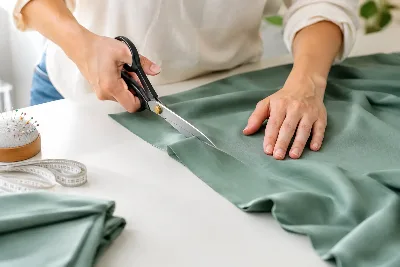
You can also cut successfully with a good pair of fabric scissors. Keep your hand flat beside the cutting line and don't push the fabric forwards. Cut with long, steady strokes. With fine viscose jersey in particular, it's better to work slowly and carefully than to rush along the whole length in one go.
If an edge curls very strongly, a little spray starch can help. It temporarily gives the fabric more body. Always test it on a scrap first, though, especially with dark, printed or very delicate fabrics. The starch should make handling easier, not permanently change the soft drape of the jersey.
When sewing: add stability without losing stretch
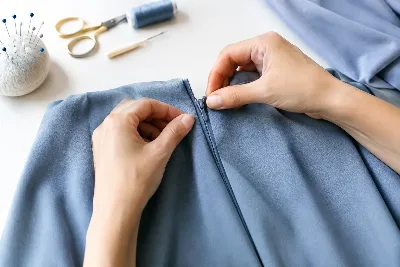
The open cut edge doesn't have to stay flat for a seam to work. What matters is that the two layers of fabric line up properly along the seam line. Secure them with clips or a few pins before sewing, and feed the fabric under the presser foot without pulling.
A jersey or stretch needle is a good choice here. Its tip pushes the loops aside instead of damaging them. For most seams, a narrow zigzag stitch, a stretch stitch on your domestic sewing machine, or an overlocker will do the job. Which option suits best depends on your project and your machine. An overlocker finishes and sews quickly, but a regular sewing machine with the right settings also gives lovely results.
If the seam distorts, check the presser foot pressure and thread tension first. Jersey often goes wavy because the fabric gets stretched while sewing. A walking foot can help move both layers along evenly. For shoulder seams, necklines or button plackets, it makes sense to stabilise the seam deliberately – for example with a narrow stay tape or a suitable seam tape. These are the places where you don't want the garment to stretch out.
Hems that won't curl
An open jersey edge curls; a hemmed edge usually doesn't. For a classic hem, you can fold the edge under once and stitch it down with a twin needle or a stretch stitch. With very thin jersey, a double-folded hem looks neater, but it's a little bulkier.
Alternatively, you can bind the edge with ribbing, a strip of jersey or a facing. This looks especially nice on necklines, sleeves and children's clothes. A facing or ribbing doesn't just keep the edge looking tidy – it also gives the finish stability.
Not every curling edge has to disappear, though. On some light summer tops, scarves or decorative jersey flowers, the rolled edge is even a deliberate design feature. In that case, don't fight it – instead, check on a test piece beforehand that the effect looks even and suits your project.
When jersey suddenly curls more than expected
Sometimes the difference isn't down to the fabric but to the surroundings. Very dry indoor air can make lightweight qualities build up static. The jersey then clings to your hands, the table or the pattern paper and seems more restless. A slightly damp pressing cloth or a little more humidity in the room can help.
Its behaviour can also change after washing. If jersey is tumbled hard in the dryer or dried very hot, it can become more compact and behave differently at the edges. So always follow the care instructions for the particular quality. For a project you're unsure about, a small test piece is worth its weight in gold: wash, dry, press, cut and test a seam. It'll save you a lot of frustration later on.
At Die Stoffkönigin, we're always happy to help you decide whether a soft single jersey, a more stable interlock or a matching ribbing is the better choice for your project. Especially if you only want to add a small detail, you can easily try out the material and its effect on a modest piece.
So a curling jersey edge isn't your enemy at the sewing table – it's a reminder that you're working with a lively, stretchy fabric. Give it a little calm when cutting, don't keep it under tension while sewing, and choose an edge finish that suits your project – and this little quirk will quickly become a very manageable part of sewing.