Guide: how to calculate fabric quantities for cushion covers
A cushion should end up plump and neat, not squeezed into a cover that's too tight or lost in too much fabric. Our guide to fabric quantities for cushion covers helps you estimate realistically how much you need before you start cutting. Besides the size of the cushion, the closure, seam allowance, fabric width and print all determine how much fabric by the metre actually belongs in your basket.
The basic rule for cushion cover fabric quantities
First, measure your cushion pad at its widest point. With a new pad you can usually rely on the stated size, such as 40 x 40 cm or 50 x 50 cm. With older, well-filled pads, however, it's worth measuring again: their filling may mean they need a little more room.
For a classic cushion cover made from two pieces of the same size, you calculate the cushion size plus seam allowance for each side. With a 1 cm seam allowance all round, a 40 x 40 cm cushion needs two pieces cut at 42 x 42 cm each. So you'll need two squares of that size.
The formula is:
Cushion size + seam allowance on the left and right = cutting size per fabric piece.
With a 1 cm seam allowance, 40 cm therefore becomes 42 cm, and 50 cm becomes 52 cm. If you'd like to work the edges with a wider seam allowance, or want extra leeway to adjust the cover after washing, allow a little more accordingly.
The cushion pad needs a little room to move
A cover doesn't need to be cut larger than the cushion pad. Quite the opposite: if it's sewn about 1 cm smaller than the cushion size, the cushion often looks beautifully plump. This works especially well with soft cushion pads and stretchy fabrics. With firm cotton fabrics, thick fillings or precise envelope closures, though, it's less stressful for beginners to plan with the stated cushion size at first.
Fabric requirements for popular cushion sizes
The following quantities are based on woven fabric at least 140 cm wide, a 1 cm seam allowance and a simple cover made from a front and back piece. The figures are deliberately rounded with real-life sewing in mind – a little leeway makes cutting much easier.
- 30 x 30 cm: about 35 cm of fabric for one cover
- 40 x 40 cm: about 45 cm of fabric for one cover
- 50 x 50 cm: about 55 cm of fabric for one cover
- 60 x 60 cm: about 65 cm of fabric for one cover
With a fabric width of 140 cm, you can often cut several 40 x 40 cm cushion covers from 45 cm of fabric. Imagine the squares you need laid side by side across the width of the fabric: three pieces of 42 cm each add up to 126 cm, so they fit across the width. From a 45 cm length you'll get three front pieces of the same size or, depending on how you plan your cutting layout, matching covers for several cushions.
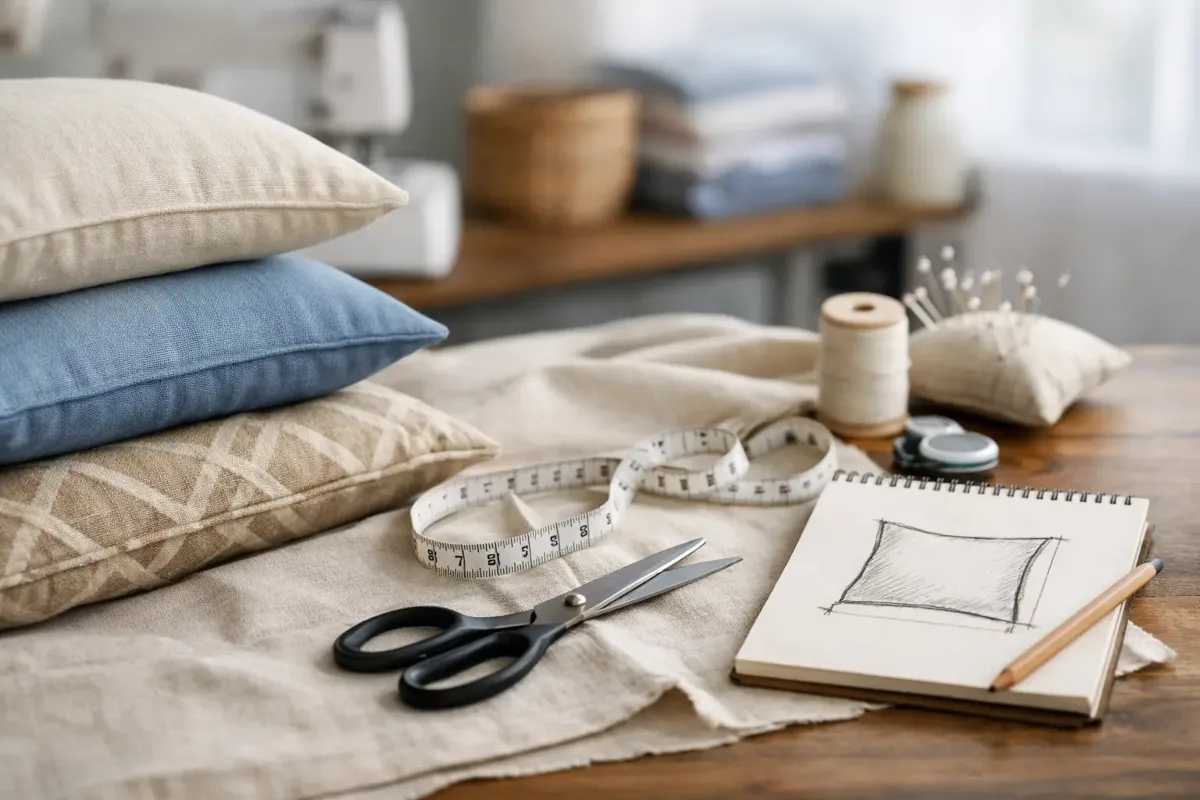
This shows why it's worth making a quick sketch before you buy. If you're planning two or four cushions, you don't automatically need four times the length of fabric. With decorative cushions in particular, the fabric width is often the deciding advantage.
Fabric quantities for cushion covers with an envelope closure
The envelope closure is popular because it doesn't need a zip, buttons or press studs. The back is made from two overlapping pieces of fabric. This overlap holds the cushion pad in place and has to be planned in on top of the cushion width.
For a 40 x 40 cm cushion, cut the front piece at 42 x 42 cm. For the back you need two pieces, each 42 cm high. For the width, add half the cushion width, the overlap you want and a hem. For this cushion size, two back pieces of roughly 42 x 30 cm work well. Hem the open edge of each back piece first, then lay the pieces overlapping on the front piece and sew all the way round.
Depending on your cutting layout, an envelope closure can need more fabric than two simple squares. For a single 40 x 40 cm cushion, 50 cm of fabric at 140 cm wide is usually a comfortable amount. If you want to position the print precisely, a little extra is a good idea.
Zip or buttons: what changes?
With a zip in the bottom seam, the front and back pieces basically stay the same size. So you hardly need any extra fabric – just a suitable zip and a little patience when sewing it in. A concealed zip looks especially neat, but it isn't the quickest option for your first cushion project.
Buttons, ties or press studs also need only a little extra fabric. If you're adding a separate button placket, though, allow for a strip about 6 to 8 cm wide. If you're working with small remnants, you can deliberately choose this strip in a contrasting colour – as long as the fabric weight and washability are compatible.
Planning for fabric width and direction
The quantities for cushion covers work most simply with fabrics in a standard width of 140 to 150 cm. Narrower home décor fabrics, linen or remnants, on the other hand, need their own calculation. Note down the cutting sizes of all the pieces and arrange them on a sheet of paper just as they would lie on the fabric, with the width of the paper representing the width of the fabric.
With plain colours you can usually turn the pieces any way you like, which saves fabric. With stripes, checks, florals with a clear top and bottom, or animal motifs, it's a different story: all the pieces must face the same direction. That increases the amount you need, because you can't rotate the pieces freely.
With large prints, also pay attention to the pattern repeat. If you want a flower, animal motif or graphic element centred on each cushion, you'll need more fabric than for random cutting. It's better to allow 20 to 30 cm extra here. That's not waste – it's the difference between a lovely cover and a motif that disappears right into the seam.
Which fabrics are suitable for cushion covers?
For home cushions, woven cotton, canvas, home décor fabrics, linen blends and corduroy are particularly easy to work with. They cut accurately, can be neatened with a zigzag stitch if they fray, and hold their shape well. Canvas and upholstery fabrics are nicely hard-wearing, but can get a bit bulky where several layers meet at the seams. A universal needle in a suitable size and a slightly longer straight stitch will help here.
Jersey works well for soft, cosy cushions, but needs a little more care. Because the fabric stretches, the edges can distort as you sew. Use a stretch needle and stabilise the seam with narrow stay tape if needed. For very plump cushion pads, woven fabric is often the easier choice.
Fleece, teddy plush or double gauze also make lovely covers, especially for a child's bedroom or a snug reading corner. With bulky fabrics, trim the seam allowance back a little after sewing and choose a cushion pad that isn't too firmly filled. Otherwise the corners quickly become thick and lumpy.
Seam allowance, washing and a little extra
Seam allowance is often forgotten right at the cutting stage – and then you're missing exactly the one centimetre that makes the cover fit. If you're working with a sewing pattern, always check whether the seam allowance is already included. For squares you've drawn yourself, you'll need to add it.
Natural fibres such as cotton or linen can shrink in the first wash. If the finished cushion cover is going to be washable, it's best to wash the fabric before cutting, just as you plan to care for it later. This applies especially to strongly dyed fabrics and to fabrics you're combining with other materials.
A little extra also helps if you're not yet used to cutting straight, or if the cut edge of the fabric arrived slightly crooked. At Die Stoffkönigin, fabric by the metre is available from just 20 cm – handy for a single small project, but for patterned cushion covers it's fine to plan more generously.
A quick check before you order
Before you decide on your fabric quantity, ask yourself three questions: What size is the cushion pad? Which closure do you want to sew? And does a print need to run in a particular direction or sit in a particular position? Once these points are clear, you can work out your requirements reliably.
If in doubt, add a few extra centimetres, especially for large motifs, envelope closures and fabrics that still need washing before sewing. A small leftover can later become a lavender bag, a mini cushion or a matching hanging decoration – but a missing piece of fabric can rarely be added invisibly.