How to Use Temporary Spray Adhesive for Embroidery
A fine jersey slips as you hoop it, a small name label goes out of shape or appliqué fabric lifts at the edges: if you want to embroider with temporary spray adhesive, you'll know these situations well. This temporary adhesive can hold fabrics and embroidery stabiliser reliably in place without pins, tacking stitches or tape getting in the way. Used correctly, it saves time and gives you a clean embroidery result. Too much adhesive, the wrong surface or poor ventilation, on the other hand, can quickly cause more trouble than it solves.
When spray adhesive makes sense for embroidery
Temporary spray adhesive is a short-term adhesive that comes in a can. It bonds two layers only for as long as you need them for your embroidery project. This is particularly handy for materials that won't fit into an embroidery hoop, or only with difficulty. These include finished T-shirts, bags, hats, small pieces of fabric, delicate fabrics, and also felt and faux leather.
The adhesive is very often used to attach embroidery stabiliser underneath a fabric. The stabiliser then lies flat and can't shift. With the so-called floating technique, only the stabiliser is hooped, while the fabric is stuck on top. This is a good solution for areas that can't be hooped, such as a bag that has already been sewn up or a T-shirt that you'd rather not mark with hoop burn.
It's also a handy helper for appliqué. Small fabric pieces stay in place before they're stitched over, and you don't need to secure them with lots of pins. With lightweight cottons or woven fabrics, this can be really convenient. With stretchy fabrics such as jersey, however, spray adhesive is no substitute for the right embroidery stabiliser. It holds things in place, but it doesn't provide lasting stability against pulling and distortion.
The right adhesive for embroidery projects
For your embroidery machine, you need a temporary spray adhesive that is specifically suitable for textiles, embroidery stabiliser or sewing projects. Ideally, it should wash out without leaving residue once you've finished. Craft glue, contact adhesive or permanent sprays have no place on fabric or stabiliser, or anywhere near your embroidery machine.
Also consider whether you're working with washable materials. For clothing, bibs, towels or cushions, a wash-out adhesive is the safe choice. For décor items that won't be washed later, residue is less of an issue, but even here too much spray can make the fabric surface look dull or attract dust.
A quick test is always worthwhile. Spray the adhesive onto a scrap of the fabric, press it onto stabiliser and pull the layers apart again after a few minutes. This shows you how strongly the adhesive holds and whether the surface reacts badly. This is especially important with coated fabrics, faux leather, velvet, very fine viscose and water-repellent materials.
Using spray adhesive for embroidery: how to get a clean result
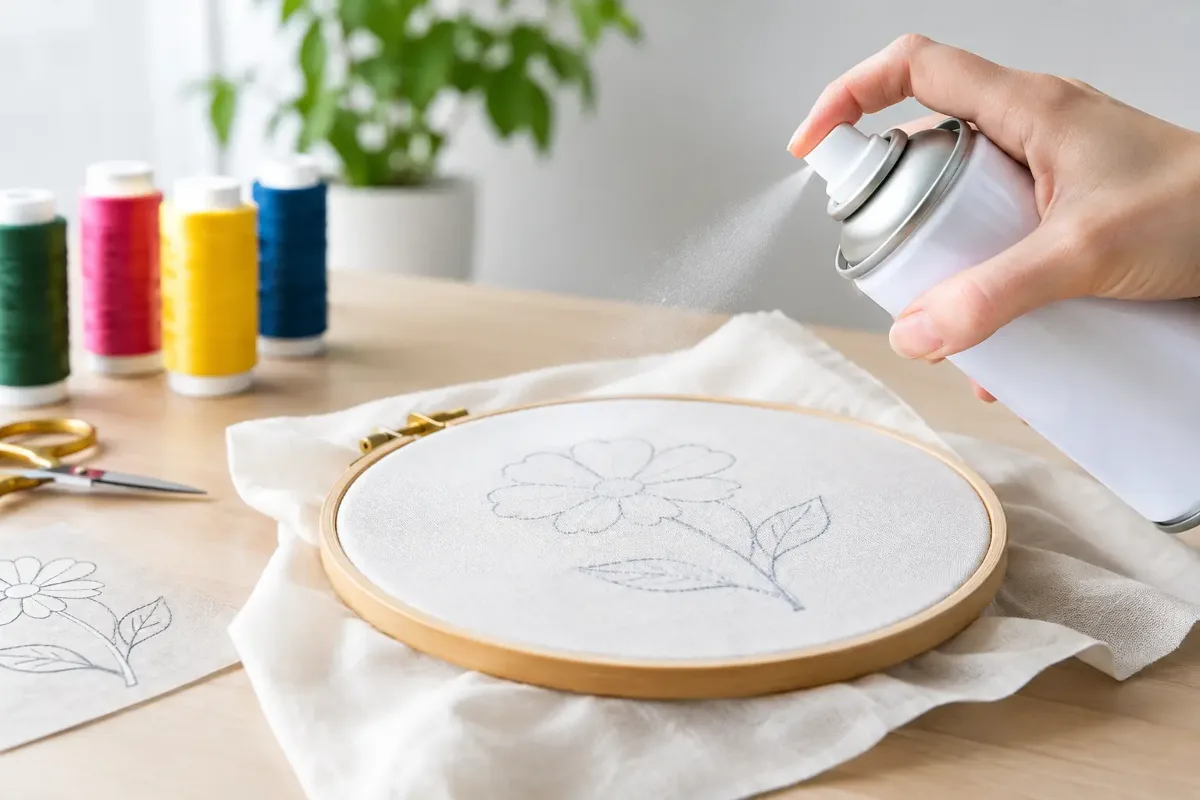
The most common mistake happens before you even start stitching: the adhesive is sprayed generously onto fabric and hoop right at the workspace. The fine mist soon ends up on the table, machine, floor or thread spools. It's better to use a protected spraying area, such as a large cardboard box or a piece of card kept just for this purpose.
1. Choose a stabiliser to suit the fabric
First, choose your embroidery stabiliser according to material and design. A light design on a firm woven fabric needs something different from a densely stitched design on jersey or sweatshirt fabric. Tear-away stabiliser is often suitable for stable fabrics, cut-away stabiliser for stretchy materials and water-soluble stabiliser for lace, towelling or delicate effects. The spray adhesive helps with positioning, but the support comes from the stabiliser.
Hoop the stabiliser so it's smooth. It should be taut, but not stretched to its limit. With thicker or delicate fabrics, you can lay the fabric on the hooped stabiliser afterwards rather than hooping both layers together.
2. Spray sparingly and from a distance
Wherever possible, spray the stabiliser rather than the fabric. Hold the can about 20 to 30 centimetres away and move it evenly. One short, fine burst is usually enough. The stabiliser should become slightly tacky, not visibly wet and shiny.
Let the adhesive air for a few seconds. It will then stick in a more controlled way and be less stringy. Next, lay the fabric on the stabiliser without stretching it and gently smooth it out from the centre towards the edges. Keep an eye on the grainline and make sure there are no creases under the embroidery area.
3. Position the design and check with a trace
Use your embroidery machine's design trace function if it has one. This lets you check before you start that the design really sits within the area you want. Especially on pocket flaps, cuffs or finished garments, this quick step saves you from a misplaced design.
For appliqué, you can also fix the fabric piece lightly with spray adhesive. Use only a thin layer so that the needle isn't slowed down by too much adhesive later on. After the first tack-down stitch, check that the fabric is lying flat before the satin stitches enclose the edge for good.
What can go wrong when embroidering with spray adhesive
If the needle gets sticky, the thread breaks or small bits of adhesive build up on the needle plate, too much spray has usually been used. Stop the machine, carefully clean the needle and needle plate and fit a new needle if necessary. A blunt needle or one coated in adhesive can visibly spoil the stitch quality.
Stabiliser that has been sprayed too heavily is also a problem. The fabric may not lie evenly, and fine materials can end up with marks or pressure spots. In this case, applying even more adhesive won't help. Let the surface dry first and start again with a fresh piece of stabiliser.
With very large, heavy or highly textured fabrics, spray adhesive alone sometimes isn't enough. It can then make sense to use your machine's basting stitches as well, or to tack the fabric carefully in a non-critical spot. The same applies to high-pile fleece and thick towelling. Here, a water-soluble topping such as Avalon placed on top of the fabric also stops the stitches from sinking into the pile.
Safety and working cleanly
Only use spray adhesive in well-ventilated rooms. Open a window, don't spray close to children or pets and avoid naked flames. Don't heat the can, and always follow the manufacturer's instructions.
Cover your embroidery machine and work table before you spray. A cardboard box with high sides catches the spray mist well. When you've finished, close the can and put the spraying area away. That way your creative space stays pleasant, and adhesive residue doesn't spread unnoticed onto fabrics or tools.
If you embroider often, it's worth keeping a few scraps of fabric and stabiliser handy for testing. Especially with new combinations of fabric, thread, stabiliser and design, a few test stitches quickly show whether the stabilisation is right. At Die Stoffkönigin, you'll find fabrics, embroidery stabilisers and suitable accessories for many of these combinations - and if you're unsure, a personal opinion on your planned project often helps.
When you're better off without spray adhesive
Not every embroidery project needs adhesive. If fabric and stabiliser can be hooped together neatly, that's often the simplest solution. With very loosely woven, heavily fraying or delicately coated fabrics, a test may also show that tacking or a suitable self-adhesive stabiliser works better.
For small designs on stable cotton, a good embroidery hoop, the right stabiliser and careful tensioning are often all you need. Spray adhesive isn't a must, but a helpful tool for those cases where it genuinely makes positioning easier.
Before the first spray, take a moment for a fabric test, choosing your stabiliser and positioning your design. Then the adhesive stays exactly what it should be: an inconspicuous helper in the background, so that your embroidery design gets all the attention.