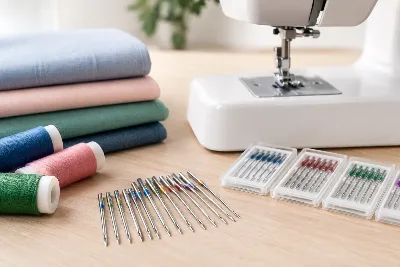
Which needle for canvas when sewing bags and home decor?

If your machine suddenly just stabs at the corner of a bag instead of sewing it, the problem often isn't the fabric but the needle. That's why the question "Which needle for canvas?" is so important before your project goes under the machine. Canvas can range from a pleasantly crisp cotton fabric to a very firm bag fabric. With the right needle, you get neat seams, the fabric is treated gently and your sewing machine doesn't have to struggle unnecessarily.
Which needle suits your canvas?
For classic cotton canvas, a size 90 universal needle is usually a good place to start. It's sturdy enough for lots of bags, cushion covers, fabric storage baskets or decor projects and gives a neat stitch. For lighter canvas, such as for aprons, single-layer fabric baskets or garment details, an 80 needle may well be enough.
If the fabric is denser, several layers come together, or you're also sewing through webbing, interfacing or reinforcements, a size 90 or 100 jeans needle is often the better choice. Its particularly slim, sturdy point reliably pierces tightly woven materials. It's also less likely to bend at thick seam junctions than a fine universal needle.
The most important rule is this: don't choose your needle just because the fabric is called canvas – choose it for your specific project. A thin decor canvas needs something different from a lined shopping bag with a reinforced base.
Choosing the right needle size for canvas
The number on the needle packet indicates its size. The higher the number, the thicker the needle shaft. A needle that's too fine can bend, break or cause skipped stitches in dense canvas. A needlessly thick needle, on the other hand, leaves larger holes that can remain visible, especially on light-coloured or coated fabrics.
Light canvas and simple seams
For light to medium-weight canvas with one or two layers of fabric, a universal 80 or 90 needle usually does the job. That applies to cushion covers, bunting, simple fabric baskets without heavy reinforcement or aprons, for example. Sew a small test piece first using the same thread and check that the seam lies flat and doesn't form loops.
Bags, backpacks and multiple layers
For bag projects, a jeans needle 90 is a very reliable choice. If several layers of canvas meet, or base interfacing, bag interfacing and webbing are added, go for a jeans needle 100. It's especially helpful on side and base seams, at the ends of zips or where handles are attached.
A 110 needle only makes sense for genuinely heavy sections. It isn't a cure-all. If your domestic sewing machine stalls at a thick seam crossing, even a heavier needle can reach its limits. In that case, it's better to trim the seam allowances, stagger thick layers or sew slowly over the spot using the handwheel.
Coated canvas and waxed canvas
Coated canvas needs a little more care, because needle holes can stay visible permanently. A fresh Microtex needle in size 80 or 90 is often ideal here. Its fine, very sharp point places precise stitches and is kind to the surface. A new universal needle can also work, but on smooth or heavily coated qualities, Microtex often gives the nicer result.
Try not to pin coated canvas in areas that will be visible. Sewing clips are the better choice. If you have to unpick a seam, the old holes may remain visible – so a test piece is particularly valuable with fabrics like these.
Universal, jeans or Microtex needle?
A universal needle is the easy-going all-rounder for standard canvas. It works well if your fabric isn't extremely dense and you're using ordinary all-purpose thread. For lots of decor ideas and simple bags, you don't need anything more.
A jeans needle is worth it when canvas is firm, dense or sewn in several layers. Despite its name, it isn't just for denim. Especially for bags, organiser covers, backpacks and baskets, it gives you more stability while sewing.
A Microtex needle is the specialist for coated, smooth and tightly woven canvas. It's also helpful when you want precise topstitching to be on show. For very thick seam bundles, however, it isn't automatically better than a jeans needle.
Leather needles don't belong anywhere near canvas. Their cutting point is designed for leather and can damage woven fabrics unnecessarily. You don't need a stretch needle for pure canvas either – it's designed for stretchy fabrics such as jersey.
Thread and stitch length need to play along
Even the best needle can only do its job if the thread and settings suit the fabric too. For most canvas projects, a high-quality, strong polyester all-purpose thread is a good choice. It reliably holds bags and decor items together in everyday use and comes in lots of colours.
If you'd like visible contrast seams or a striking bag look, you can use a heavier topstitching thread. In that case, a jeans or topstitch needle in 90 or 100 is often recommended. The larger eye lets the thicker thread glide through more easily. Test the thread tension as you go: if the upper tension is too tight, it will pucker the seam, while tension that's too loose can create loops on the underside.
With canvas, the stitch length can be a little longer than with fine cotton. Around 3 to 3.5 millimetres is a good starting point for normal seams. For visible topstitching, you can go a little longer. Very small stitches perforate dense fabric more and make a seam look stiffer.
When canvas gets tricky on the machine
If the seam frays, the needle breaks or the machine skips stitches, changing the needle is the first sensible step. Needles wear out. After a larger bag project, after sewing through lots of thick layers or at the latest when you hear a noticeable thudding sound, it's time to put a new needle in the machine.
The presser foot makes a difference too. A walking foot or a built-in dual feed helps when several layers of canvas shift against each other. With coated canvas, a Teflon foot or a piece of tissue paper between the foot and the fabric can stop the surface from dragging. Carefully tear the paper away after sewing.
Don't force the pedal at thick transitions. If needed, raise the presser foot slightly with a height compensation tool so that it sits level. Sew slowly and turn the handwheel when the needle has to get over a particularly thick spot. This reduces the risk of the needle hitting the needle plate or snapping.
Avoiding common mistakes with canvas
A common mistake is sewing through several firm layers of canvas with an old size 70 universal needle. It might work at first, but it often leads to wonky stitches, a bird's nest of thread or a broken needle. It's just as unhelpful to start every thick project straight away with a 110 needle. On fine canvas, the visible holes are usually unnecessarily large.
Also bear in mind that a fabric's firmness isn't only down to its weight. Iron-on reinforcement, volume fleece, Decovil, webbing or a zip make a seam bundle considerably thicker. Plan for these areas when cutting out: seam allowances can be carefully trimmed or graded at junctions so that the layers don't all sit exactly on top of each other.
Test first, then sew the bag
Before starting the actual project, cut two small scraps of canvas and layer them exactly as they'll be at the thickest point of your bag. Sew a straight seam, a curve and – if needed – a seam over webbing. That way you'll quickly see whether the needle, thread, tension and stitch length work together.
For standard canvas, a universal 90 needle combined with all-purpose thread is often just right. For firm bag layers, a jeans needle 90 or 100 gives you more confidence, and on coated canvas a fresh Microtex needle sews especially cleanly. A small test piece beforehand turns a guess into a good decision – and your canvas project can be a joy from the very first seam.