


This fabric comes in 28 colours
- Brilliant White 401
- White 400
- Beige 405
- Beige Melange 495
- Neon Yellow 425
- Mustard Yellow 423
- Neon Orange 427
- Red 436
- Dark Red 438
- Pink 431
- Pink Melange 483
- Neon Pink 432
- Violet 451
- Pastel Blue 450
- Turquoise 447
- Blue Melange 485
- Blue 456
- Dark Blue 459
- Neon Green 445
- Green Melange 494
- Green 446
- Dark Green 448
- Brown 479
- Dark Brown 478
- Grey Melange 492
- Grey 493
- Anthracite 498
- Black 499
Felty turns into appliqué, labels and patches — cut, stitch, sew on, done. At 25 cm wide and 3 m on the roll there is material for several projects. Its weight per square metre is 210 g/m².
It also suits craft work with children, since nothing frays and nothing needs finishing. The felt is dense enough to embroider and soft enough to cut and drape — the whole art of a good embroidery felt lies between those two. Before the first design on a new fabric, a test piece with the same material pays off.
What Sulky Felty Stickfilz Neongelb is suitable for
- labels and patches
- craft work with children
- buttons and badges
Sewing tips
- Der Filz franst nicht, die Kante braucht also keine Versäuberung.
- Zum Besticken ein Stickvlies unterlegen, sonst zieht die Stichdichte den Filz zusammen.
- Waschbar bei 30 °C — Applikationen halten damit auch an Kleidung, die regelmäßig gewaschen wird.
- Mit einer scharfen Schere oder dem Rollschneider zuschneiden; stumpfe Klingen ziehen Fasern.
- Für Aufnäher den Filz mit Aufbügelvlies hinterlegen, dann bleibt die Form auch nach dem Aufbügeln erhalten.
Available in more colours in the Sulky Felty Stickfilz series.
Frequently asked questions
What do I cut it with?
Sharp scissors or a rotary cutter. Blunt blades drag fibres out of the surface, and the edge then looks ragged even though felt cannot actually fray.
How do I make a patch from it?
Stitch the design, cut it out, back it with fusible stabiliser and press it on. An edge stitch makes it durable — especially where a piece rubs while worn.
Can I glue felt instead of sewing?
For decor yes, for clothing rather not. Glued joints lift at the edges in the wash. Combining both — glue and edge stitch — gives the most durable result.
Does an appliqué hold without stitching?
In the short term yes, permanently no. Washing and rubbing lift a glued edge. A narrow zigzag or straight stitch around it settles the matter for good.
Care instructions:
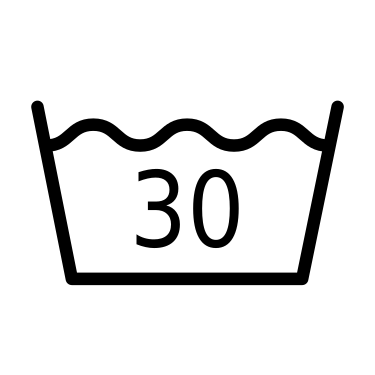
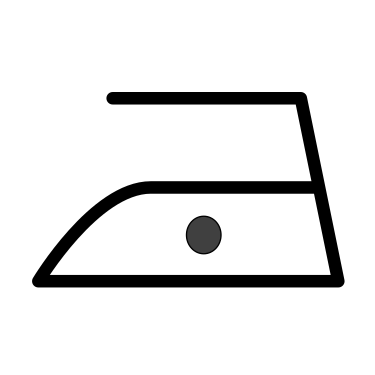
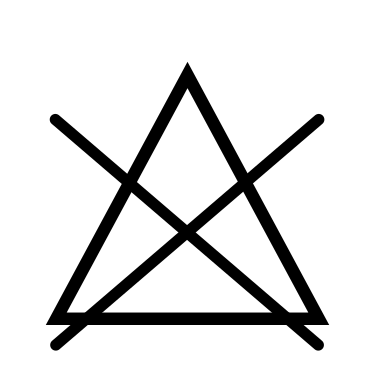

Daten und Pflege
- Width
- 25 cm
- Colour
- Neongelb
- Thickness
- 1,5 mm
- Length (m)
- 3 m
- Colour code
- 425
- Material
- 100 % Polyester
- Artikelnummer
- 599026728